


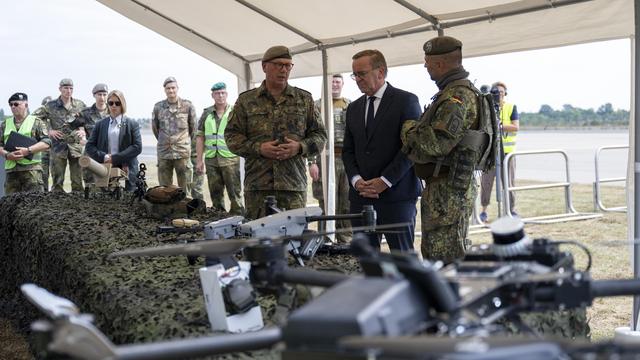
Defense: Economist Schularick accuses Pistorius of wrong investments
Translated from German, summarized and contextualized by DistantNews.
At a glance
News
Named sources
Context piece
- An economist criticizes German Defense Minister Boris Pistorius for misdirecting military investments.
- The economist advocates for prioritizing AI, robotics, and drones over traditional weaponry.
- He also calls for a reform of the defense procurement process, suggesting a central coordinator.
Moritz Schularick, president of the Kiel Institute for the World Economy (IfW), has accused German Defense Minister Boris Pistorius of making incorrect investment choices for the nation's defense.
Schularick argues that instead of strategically investing the substantial funds available for defense and rearmament by 2030 into future-oriented weapon systems, Pistorius is allocating a significant portion to outdated technologies like tanks and frigates. The economist believes the 700-billion-euro Bundeswehr modernization program risks failing to achieve its objectives.
"We have a lot of capital, a lot of industrial know-how, and in some areas, still highly modern technologies," Schularick told the Süddeutsche Zeitung. "What we don't have are hundreds of thousands of people who want to get into tanks and drive to the front. That means: instead of more soldiers, more manned vehicles, and more barracks, we must rely on AI, robotics, drones, and satellite technology wherever possible."
Schularick views the German and European defense strategy reorganization as an overwhelming task for a single, slow-moving ministry. He proposes appointing a central coordinator for military procurement within the Chancellery. This individual, empowered with political authority, would unite industry, startups, and ministries, resolve friction points, and focus efforts on a single goal.
Furthermore, Schularick insists that both the German government and industry must fundamentally change their approach to arms procurement. Simply spending money and replenishing Bundeswehr stocks is insufficient. "Rather, we must think from the beginning about what the economic processes must look like so that the necessary weapon systems can actually be produced quickly and in sufficient quantities in case of need," he stated. He suggests ordering "the entire factory" rather than individual complex systems, enabling rapid scaling of production, such as producing 2,000 missiles annually instead of 200. Since maintaining such a factory is not profitable for companies in peacetime, the state must offer a premium payment.
DistantNews Editorial
Originally published by Die Zeit in German. Translated, summarized, and contextualized by our editorial team with added local perspective. Read our editorial standards.
More Stories
From Our Blog

What Gets Lost (and Found) When News Is Translated

How the Same Story Looks Different in Different Countries

The Critical Role of Diaspora Media in Global News

What Travellers Should Know About Countries with Restricted Press

A Digital Nomad's Guide to Following Local News
