


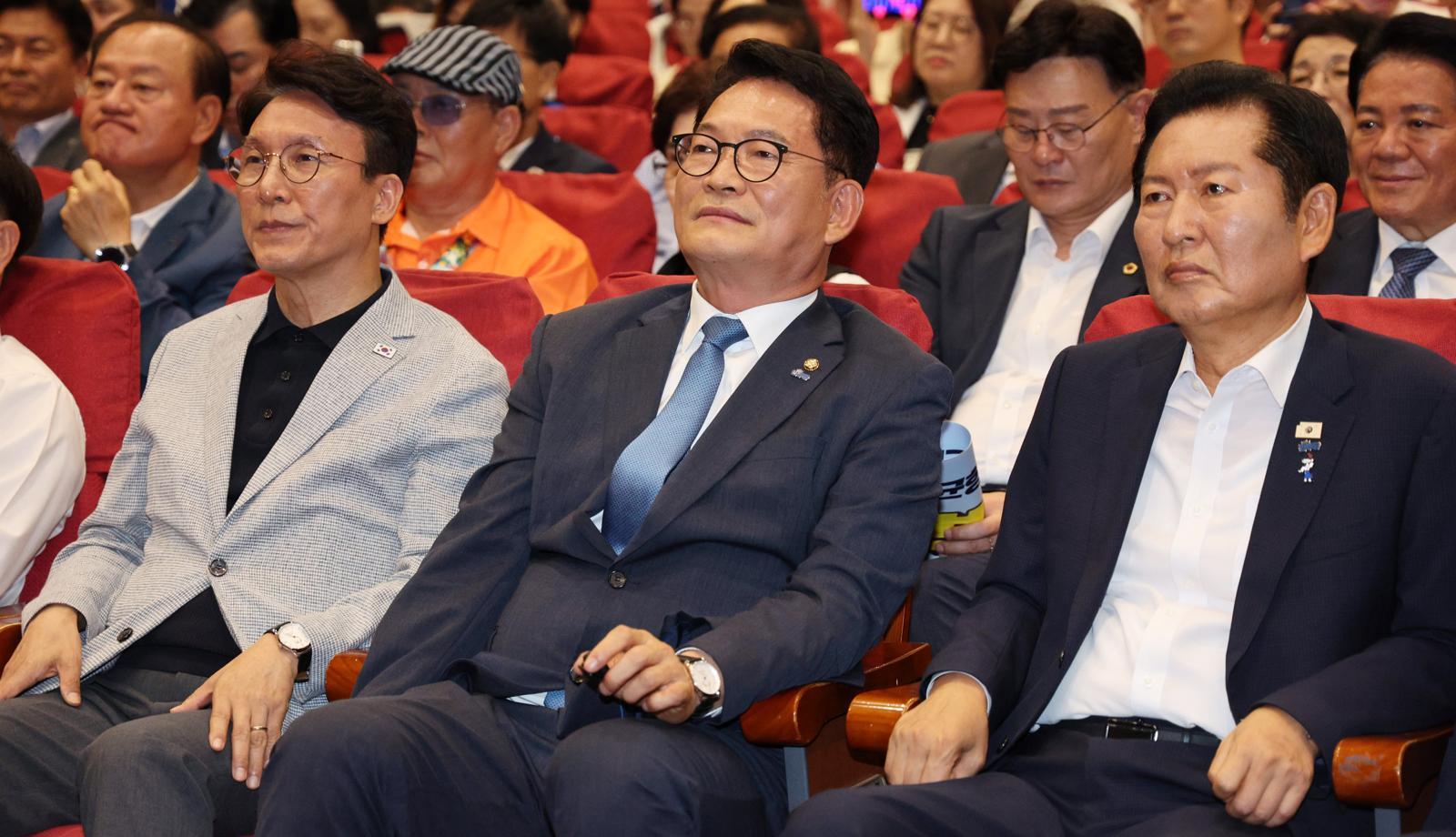
Democratic Party rivals attack Jeong Cheong-rae over 'anti-Lee' remarks
Translated from Korean, summarized and contextualized by DistantNews.
At a glance
News
Named sources
Outcome reported
- Democratic Party leadership candidates Kim Min-seok and Song Young-gil criticized former party leader Jeong Cheong-rae.
- The dispute centers on Jeong's statement that those who speak against Lee Jae-myung are anti-Lee.
- Candidates debated party leadership, strategy, and loyalty to President Lee Jae-myung.
Tensions are rising within the Democratic Party as leadership candidates clash over loyalty to President Lee Jae-myung. Former party leader Jeong Cheong-rae asserted that anyone speaking against President Lee is inherently against him, stating, "Those who mention anti-Lee are anti-Lee, and those who mention division are divisionists." He added, "Those who mention anti-Lee division are the actual anti-Lee divisionists." Jeong vowed to focus on "integration and reform" and avoid negativity. However, presidential hopeful Kim Min-seok countered that an "anti-Lee trend objectively exists." Speaking on MBC radio, Kim argued that the current party leadership's performance over the past year has been insufficient for generating new policy agendas and national tasks. He suggested that leadership changes are necessary due to "competence issues" and "self-serving politics."
Those who mention anti-Lee are anti-Lee, and those who mention division are divisionists. Those who mention anti-Lee division are the actual anti-Lee divisionists.
Song Young-gil, another contender, directly challenged Jeong's sincerity. On YTN radio, Song stated that President Lee has repeatedly indicated his discomfort with Jeong's actions, questioning Jeong's claims of unity. "Why are you lying like that?" Song asked, drawing an analogy: "If you dislike a friend, would they be happy if you loudly proclaimed your love for them in public?" Song also suggested Jeong's bid for party leadership was an attempt to build his own power base, citing the creation of 800 special advisors during Jeong's previous tenure as evidence of a focus on self-preservation rather than electoral victory.
An anti-Lee trend objectively exists.
Kim further criticized Jeong's handling of potential mergers with the Cho Kuk Innovation Party, calling it a "bomb declaration" that damaged the party. He accused Jeong of having "an excessive desire for display." The exchanges highlight a deep division within the party as it navigates its future leadership and its relationship with the current administration.
Why are you lying like that? If you dislike a friend, would they be happy if you loudly proclaimed your love for them in public?
DistantNews Editorial
Originally published by Dong-A Ilbo in Korean. Translated, summarized, and contextualized by our editorial team with added local perspective. Read our editorial standards.
More Stories


From Our Blog

What Gets Lost (and Found) When News Is Translated

The Critical Role of Diaspora Media in Global News

What Travellers Should Know About Countries with Restricted Press

A Digital Nomad's Guide to Following Local News

How the Same Story Looks Different in Different Countries
