


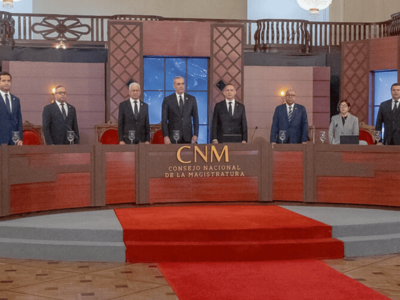
Dominican Republic: Seven Supreme Court judges called for evaluation
Translated from Spanish, summarized and contextualized by DistantNews.
At a glance
News
Sources not specified
New plan
- Seven Supreme Court of Justice judges in the Dominican Republic have been summoned for evaluation by the National Magistracy Council (CNM).
- The CNM will assess the judges' performance based on technical, ethical, and personal criteria, with public live-streamed interviews.
- Critics question the CNM's technical capacity and the political influence on judicial independence, while some judges have opted not to seek ratification.
Seven judges from the Dominican Republic's Supreme Court of Justice are set to undergo performance evaluations by the National Magistracy Council (CNM) on Tuesday, September 25. The summoned magistrates include Justiniano Montero Montero, Francisco Jerez Mena, Vanessa Acosta Peralta, Samuel Arias Arzeno, Alejandro Bello Ferreras, Fran Soto Sánchez, and Rafael Vásquez Goico.
the process will be carried out in accordance with the provisions of Regulation 2-25.
The CNM announced the process, which adheres to Regulation 2-25, will feature public, live-streamed interviews. This evaluation follows the CNM's approval on August 3 of a schedule to assess all 11 Supreme Court of Justice judges whose constitutional terms concluded this year. Three judges have reached the constitutional limit of two seven-year terms and require replacement, while four others, including Supreme Court President Luis Henry Molina, have chosen not to seek reappointment.
The evaluation process has reignited debate surrounding the methodology for assessing magistrates. While Regulation 2-25 outlines criteria such as productivity, decision quality, response time, legal contributions, integrity, independence, intellectual reputation, and public image, it lacks specific scoring or weighting. This leaves the final ratification decision to the CNM's discretion. The Constitution mandates that the CNM must justify any decision to remove judges based on legal grounds.
the CNM lacks a specialized technical structure to carry out these evaluations.
However, concerns persist regarding the scope of the CNM's authority and whether evaluations effectively become new selection processes. Institutions like the Foundation for Institutionalism and Justice (Finjus) argue the CNM lacks specialized technical expertise for these evaluations and propose a single appointment term for high court judges. Former Supreme Court President Jorge Subero Isa has also voiced criticism, suggesting that a predominantly political body's control over judicial tenure can compromise the perception of judicial independence and encourage lobbying.
the permanence of judges depends on a predominantly political body.
DistantNews Editorial
Originally published by Diario Libre in Spanish. Translated, summarized, and contextualized by our editorial team with added local perspective. Read our editorial standards.
More Stories
From Our Blog

What Gets Lost (and Found) When News Is Translated

The Critical Role of Diaspora Media in Global News

What Travellers Should Know About Countries with Restricted Press

A Digital Nomad's Guide to Following Local News

How the Same Story Looks Different in Different Countries
