


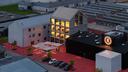
Driver of Urban Regeneration: Zabok's Regenerator Named Most Successful Architectural Achievement of 2025
Translated from Croatian, summarized and contextualized by DistantNews.
At a glance
In-depth
Named sources
Approved/passed
- The Regenerator urban culture center in Zabok, Croatia, was named the most successful architectural achievement of 2025.
- The jury praised its ability to generate a new city center and introduce a new model of urbanity in a former industrial zone.
- The project integrates culture, education, entrepreneurship, and social life into a layered public space, connecting three volumes around a central square.
The Regenerator, a center for urban culture in Zabok, Croatia, has been recognized as the most successful architectural achievement of 2025. The prestigious "Viktor Kovačić" award from the Association of Croatian Architects was presented to the project's authors from the MVA/Mikelić Vreš Architects office.
The jury highlighted the Regenerator's most significant quality: its success in "generating a new city center." Situated in Zabok's former industrial zone, the project introduces a novel urban model characterized by an open, public, and programmatically layered space. It effectively merges culture, education, entrepreneurship, and social life.
The greatest quality of the Regenerator is the fact that it succeeded in 'generating a new city center.'
The complex is designed as a cluster of three buildings surrounding a central square. This square functions not only as an entrance but as a genuine public forum and a gathering place for citizens. The jury emphasized that the Regenerator transcends a singular architectural intervention, demonstrating how thoughtfully designed public spaces can drive urban regeneration.
The project introduces a new model of urbanity – an open, public, and programmatically layered space that connects culture, education, entrepreneurship, and social life.
The architectural team included Marin Mikelić, Tomislav Vreš, Sara Pavlov, and Alma Sekondo, along with various collaborators. The City of Zabok served as the investor for the project, located at Ulice Mladih 2. In an area previously dominated by warehouses and commercial structures, the Regenerator introduces a distinct urban approach.
Connectivity at ground level is a key feature, linking the three volumes and enabling internal communication and diverse usage scenarios. This design underscores the public nature of the entire complex, functioning as a micro-city within the larger urban landscape. The project's success is attributed to its programmatic diversity, including a concert hall, musician practice spaces, rentable workspaces in the Silos building, an art cinema, association spaces, and a hostel in the Incubator, ensuring a continuous flow of users with varied interests and generations.
The jury particularly emphasized that the Regenerator transcends the level of an individual architectural intervention and shows how carefully designed public content can become a driver of urban regeneration.
DistantNews Editorial
Originally published by Večernji List in Croatian. Translated, summarized, and contextualized by our editorial team with added local perspective. Read our editorial standards.
More Stories



From Our Blog

What Gets Lost (and Found) When News Is Translated

The Critical Role of Diaspora Media in Global News

What Travellers Should Know About Countries with Restricted Press

A Digital Nomad's Guide to Following Local News

How the Same Story Looks Different in Different Countries
