


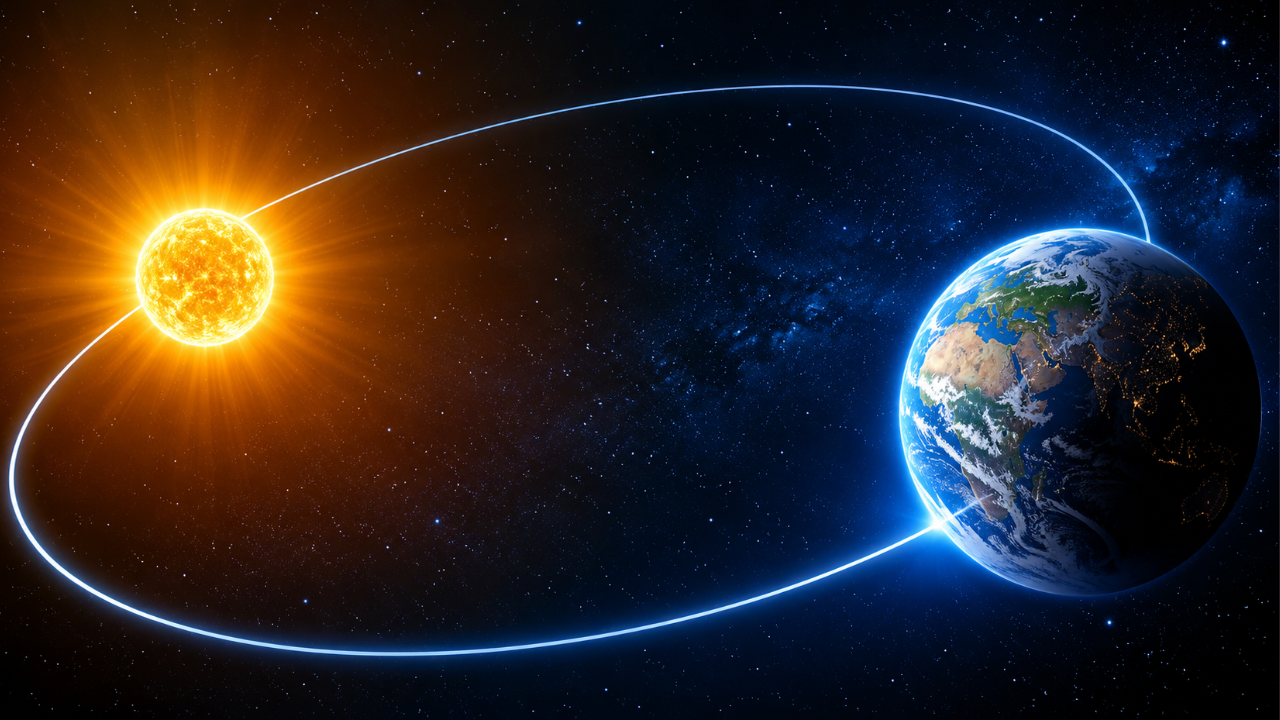
Earth reaches farthest point from Sun on July 6, but summer heat persists
Translated from English, summarized and contextualized by DistantNews.
At a glance
News
Sources not specified
Context piece
- Earth will reach its farthest point from the Sun on July 6, an event called aphelion, about 5 million kilometers farther than in January.
- Despite the increased distance, the Northern Hemisphere will experience summer heat due to the planet's axial tilt, which directs more sunlight and lengthens daylight hours.
- The tilt, not distance from the Sun, dictates seasons, with the Northern Hemisphere leaning towards the Sun in July while the Southern Hemisphere experiences winter.
Earth will reach its farthest point from the Sun on July 6, a yearly astronomical event known as aphelion. At this point, the planet will be approximately 152.1 million kilometers from the Sun, about 5 million kilometers farther than it is in early January. This greater distance, however, does not lead to cooler temperatures in the Northern Hemisphere, which remains in the grip of summer.
Scientists explain that the seasons are determined not by Earth's distance from the Sun, but by its axial tilt. As Earth orbits, it is tilted about 23.5 degrees. During July, the Northern Hemisphere is tilted towards the Sun. This tilt causes sunlight to strike the ground more directly and extends daylight hours, delivering significantly more energy to the surface than the slight reduction caused by the greater distance.
This phenomenon explains why cities in Europe, North America, and Asia continue to experience warm summer days even when Earth is at its most distant point from the Sun. The planet itself is in constant motion, rotating at high speeds while orbiting the Sun. This cosmic dance results in opposite seasons for the Northern and Southern Hemispheres, a testament to the precise workings of our solar system.
Aphelion, the point of farthest distance from the Sun, occurs on July 6 this year. The opposite point, perihelion, happens in early January when Earth is about 147.1 million kilometers from the Sun. While this difference in distance seems substantial, it represents only about 3.3 percent of Earth's average distance from the Sun.
DistantNews Editorial
Originally published by Times of India in English. Translated, summarized, and contextualized by our editorial team with added local perspective. Read our editorial standards.
More Stories


From Our Blog

What Press Freedom Means for the News You Read

What Gets Lost (and Found) When News Is Translated

The Critical Role of Diaspora Media in Global News

What Travellers Should Know About Countries with Restricted Press

A Digital Nomad's Guide to Following Local News
