


East German states demand stronger defense role, better transport links
Translated from German, summarized and contextualized by DistantNews.
At a glance
News
Named sources
New plan
- East German states met to discuss strengthening their role in national security and defense.
- They demand better transport links, particularly rail connections to Eastern Europe and more long-haul flights from Berlin.
- The states also called for increased investment and support for future industries like drone research and satellite technology.
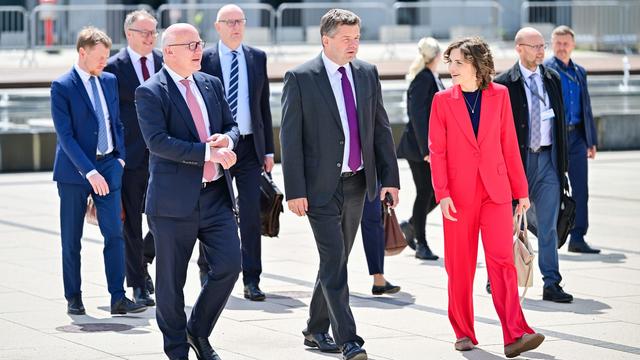
Berlin – The leaders of East German states convened for a special conference in Berlin, aiming to carve out a stronger national role in security and defense. However, they stressed that significant investments in transportation infrastructure are crucial to achieving this goal.
Massive investments are happening in the coming years. These investments must, of course, also reach East Germany.
"Massive investments are happening in the coming years," stated Berlin's Governing Mayor Kai Wegner (CDU) following the meeting at BER Airport. "These investments must, of course, also reach East Germany." The states – Berlin, Brandenburg, Mecklenburg-Vorpommern, Saxony, Saxony-Anhalt, and Thuringia – are advocating for improved rail connections, especially towards Eastern Europe, and an increase in long-haul flights originating from Berlin and Leipzig.
Beyond transportation, the East German premiers are pushing for enhanced support for emerging industries. They seek greater investment, improved funding opportunities, and stronger international cooperation in sectors such as drone research and satellite technology. The conference, held at BER Airport, was itself a symbolic gesture, with Wegner calling the airport "the gateway to the world for East Germany."
This BER is the gateway to the world for East Germany.
Disagreements surfaced regarding transportation policies, particularly concerning potential flight licenses for Emirates at BER Airport. Brandenburg's Minister-President Dietmar Woidke (SPD) voiced strong criticism of the federal government's approach, stating, "In Germany's current political situation, we cannot use this kind of internal regional protectionism at all." He also highlighted the urgent need to upgrade the Ostbahn railway line, which remains partially single-track and unelectrified on the German side.
In Germany's current political situation, we cannot use this kind of internal regional protectionism at all.
Federal Transport Minister Patrick Schnieder (CDU) and Federal Government Commissioner for Eastern Germany Elisabeth Kaiser (SPD) met with the state leaders to discuss transport connectivity. Both Wegner and Woidke called for greater transparency in the allocation of infrastructure funds, with Woidke appealing to the federal government to send "a strong signal" for economic growth in the eastern states. Schnieder acknowledged the importance of robust transport infrastructure for the competitiveness of Germany and Europe.
This transparency is obviously not there.
DistantNews Editorial
Originally published by Die Zeit in German. Translated, summarized, and contextualized by our editorial team with added local perspective. Read our editorial standards.
More Stories

From Our Blog

What Gets Lost (and Found) When News Is Translated

How the Same Story Looks Different in Different Countries

The Critical Role of Diaspora Media in Global News

What Travellers Should Know About Countries with Restricted Press

A Digital Nomad's Guide to Following Local News
