


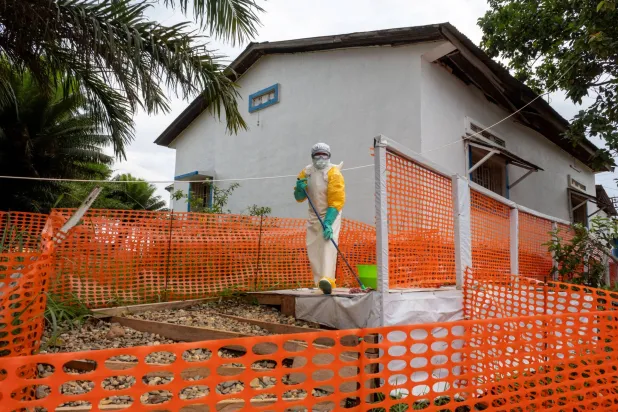
Ebola Cases in Congo Top 3,200, Nearing Record of the Country’s Worst Outbreak
Summarized and contextualized by DistantNews.
At a glance
News
Official statement
Ongoing story
- Confirmed Ebola cases in Congo have reached 3,262, with 1,437 deaths, nearing the record set by the 2018-2020 outbreak.
- This outbreak is the fastest on record, concentrated in the eastern Ituri province, and is caused by the Bundibugyo virus, which lacks approved vaccines or treatments.
- Challenges include rebel violence, health worker strikes, difficulty tracing contacts due to displacement, and community distrust, though some signs of progress and community engagement are emerging.
Confirmed cases of Ebola in the Democratic Republic of Congo have surged to 3,262, with 1,437 reported deaths, according to an overnight update from the Ministry of Health. This figure is rapidly approaching the record set by the 2018-2020 outbreak, which was the largest ever recorded in the country. Officials have described the current outbreak as the fastest on record, primarily concentrated in the eastern Ituri province. The 2018-2020 outbreak, which spanned Congo and neighboring Uganda for roughly two years, reported over 3,400 cases and more than 2,200 deaths. Globally, only the 2014-2016 West Africa outbreak had a higher toll, with approximately 28,000 cases and over 11,000 deaths. The rapid transmission in the current outbreak is occurring amidst significant concerns from residents in affected provinces. Many communities are reportedly unreachable or have been abandoned by response teams due to safety concerns stemming from attacks by angry residents and rebels. "The fact that, in just 10 weeks, we have reached nearly the same number of cases recorded over an almost two-year outbreak is alarming and should stop us in our tracks," said Onesphore Bangenza, Mercy Corps response team lead in Bunia, Ituri's capital. Bangenza added, "There is no doubt that the virus is moving faster than we can contain it." The ongoing outbreak, declared on May 15, is unusual because the responsible virus, Bundibugyo, has no approved vaccines or treatments. Efforts to curb transmission face hurdles from rebel violence in eastern Congo and strikes by health workers protesting unpaid wages. The outbreak continues to spread faster than health officials can track, despite expanding response efforts. A key challenge is the as-yet-unidentified patient zero, and displacement caused by armed conflict and illegal mining in the region complicates efforts to trace thousands of individuals who have come into contact with infected people. Despite initial distrust between communities and health workers, signs of progress are emerging. "We can never again wage war against the Ebola teams. We have lost members of our families. As a community, we have a vested interest in fighting Ebola to return to normal life," stated Fabrice Mumbesa, a resident of Mongbwalu, a mining town at the outbreak's center. Residents in Mongbwalu had previously burned down several treatment centers.
The fact that, in just 10 weeks, we have reached nearly the same number of cases recorded over an almost two-year outbreak is alarming and should stop us in our tracks
DistantNews Editorial
Originally published by Asharq Al-Awsat. Summarized and contextualized by our editorial team with added local perspective. Read our editorial standards.
More Stories


From Our Blog

What Gets Lost (and Found) When News Is Translated

The Critical Role of Diaspora Media in Global News

What Travellers Should Know About Countries with Restricted Press

A Digital Nomad's Guide to Following Local News

How the Same Story Looks Different in Different Countries
