


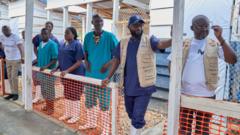
Ebola outbreak in DR Congo becomes deadliest in its history
Summarized and contextualized by DistantNews.
At a glance
News
From a news agency
Ongoing story
- The Ebola outbreak in the Democratic Republic of Congo has become the deadliest in its history, with over 2,325 fatalities.
- The current outbreak is spreading faster than previous ones, with one death occurring approximately every 30 minutes.
- While no vaccine is approved for the specific Bundibugyo species causing this epidemic, several are in development, including one using AstraZeneca's COVID-19 vaccine technology.
Public health officials have declared the ongoing Ebola outbreak in the Democratic Republic of Congo as the deadliest in the nation's history. Since its declaration on May 15th, the virus has claimed the lives of 2,325 people, surpassing the death toll of the 2018-2020 outbreak. The United Nations humanitarian chief, Tom Fletcher, described the epidemic as the fastest-growing on record, warning that it was claiming a life every 30 minutes. The specific strain responsible, the Bundibugyo species, currently lacks an approved vaccine, although several are in development. One promising vaccine is being created using the same technology that underpinned the AstraZeneca COVID-19 vaccine. As of Sunday, the DR Congo's Institute of Public Health reported 4,945 confirmed cases, with 101 new cases in the preceding 24 hours. Cases outside the DR Congo remain relatively few, with 20 confirmed in neighboring Uganda by August 12th, and isolated cases treated in Germany and France. The World Health Organization has characterized the transmission pace within the DR Congo, which has spread across six of its 26 provinces, as "exceptional." For comparison, the world's deadliest Ebola outbreak in West Africa (2014-2016) took nearly five months to reach 1,000 fatalities, while the current outbreak reached 2,000 deaths in less than three months. This marks the 17th Ebola outbreak in the DR Congo since the virus was discovered 50 years ago. The country faces significant challenges in controlling the spread due to years of conflict and a highly mobile population. The WHO aims to reverse the spread within three months by controlling transmission, though not necessarily ending the outbreak entirely. Ebola is a rare but severe viral disease, and the Bundibugyo species is particularly uncommon, with only two previous known outbreaks. Symptoms, including fever, headache, and fatigue, mimic those of the flu or malaria and can appear suddenly. As the disease progresses, vomiting, diarrhea, and organ failure can occur. Transmission is through contact with infected bodily fluids. The UK's MHRA has approved the first human trials for a Bundibugyo vaccine developed by the University of Oxford. Additionally, the WHO is sponsoring a clinical trial to assess the efficacy of two existing antiviral therapies in improving survival rates.
the epidemic is killing someone every 30 minutes
DistantNews Editorial
Originally published by BBC News. Summarized and contextualized by our editorial team with added local perspective. Read our editorial standards.
More Stories



From Our Blog

What Gets Lost (and Found) When News Is Translated

The Critical Role of Diaspora Media in Global News

What Travellers Should Know About Countries with Restricted Press

A Digital Nomad's Guide to Following Local News

How the Same Story Looks Different in Different Countries
