

Ebola patient's condition was life-threatening during Berlin treatment
Translated from German, summarized and contextualized by DistantNews.
At a glance
News
Named sources
Outcome reported
- An American doctor treated for Ebola in Berlin has recovered and been released from the hospital.
- His condition was life-threatening during treatment, particularly during transport.
- The patient received experimental treatment, including an antibody preparation and Remdesivir.
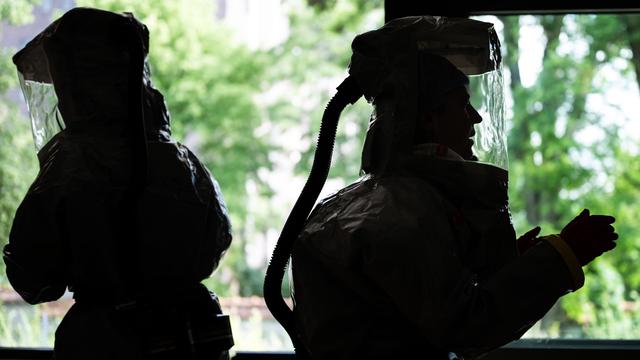
An American doctor, who contracted Ebola while working in the Democratic Republic of Congo, has been successfully treated and discharged from Berlin's Charité hospital. His condition had been critical, with doctors expressing serious concern about his survival during the journey from Africa to Germany.
These were hours where we feared that it could deteriorate so rapidly that he might not survive the transport.
Leif Erik Sander, director of the Clinic for Infectiology and Intensive Care at Charité, described the hours between the doctor's departure from Uganda and his arrival in Berlin as particularly worrying. "These were hours where we feared that it could deteriorate so rapidly that he might not survive the transport," Sander stated at a press conference.
The patient, who had contracted the virus from a patient in Congo, received a combination of treatments. This included an experimental antibody preparation called MBP134, which is still undergoing clinical trials and has limited data, and the antiviral drug Remdesivir, also used for COVID-19 patients. Sander noted that while the patient's condition stabilized quickly with this therapy, it remains unclear how the disease would have progressed without the intervention.
This means the data situation is very limited.
His wife and four children, also doctors who had been in Congo, were admitted to Charité as a precaution but showed no symptoms. They were quarantined in a separate area of the hospital. Sander emphasized the rapid and often fatal progression of Ebola in children, necessitating daily monitoring of the family.
However, under the restriction: We do not know what would have happened if these drugs had not been administered, that is how it is with individual attempts at healing.
The article also touches upon the challenges of providing treatment in Ebola-affected regions like Congo, where over 100 deaths have been confirmed. Sander expressed skepticism about the feasibility of delivering experimental treatments like MBP134 to these areas due to poor medical infrastructure and the presence of militias. He also mentioned that the initial delay in recognizing the outbreak in Congo was partly due to a lack of suitable diagnostic tests.
Therefore, my hope that the drug can actually be obtained locally is not very high.
DistantNews Editorial
Originally published by Die Zeit in German. Translated, summarized, and contextualized by our editorial team with added local perspective. Read our editorial standards.
More Stories
From Our Blog

What Gets Lost (and Found) When News Is Translated

How the Same Story Looks Different in Different Countries

The Critical Role of Diaspora Media in Global News

What Travellers Should Know About Countries with Restricted Press

A Digital Nomad's Guide to Following Local News
