


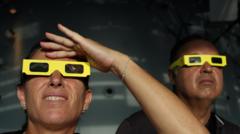
Eclipse glasses: What to do with them after the celestial show
Translated from English, summarized and contextualized by DistantNews.
At a glance
News
Sources not specified
Context piece
- Millions in mainland Europe witnessed the first total solar eclipse in over 25 years, with some in the UK scrambling to obtain special eclipse glasses.
- Eclipse glasses are difficult to recycle due to mixed materials, but cardboard frames can be separated for recycling.
- Options for used eclipse glasses include saving them for the next major solar eclipse in 2027 or donating them.
Millions across mainland Europe enjoyed a spectacular total solar eclipse on Wednesday, the first in more than 25 years. For some in the UK, acquiring the necessary protective eclipse glasses became a race against time amid growing shortages.
Eclipse glasses are a great example of our single-use culture
For those who managed to secure a pair, the question now is what to do with them. Dr. Renee Tonkin, founder of environmental education organization Science Owl, highlighted that eclipse glasses exemplify a "single-use culture" and are challenging to recycle due to their mixed materials.
Particularly because they're difficult to recycle due to their mixed materials.
Recycle Now advises that while cardboard frames can be recycled if separated from the lenses, the glasses are not entirely recyclable in household waste. Several options exist for these eye-saving spectacles. One is to save them for the "eclipse of the century" in 2027, a total solar eclipse expected to last six minutes and 23 seconds, the longest on land since 1991. This event will be visible from southern Spain, North Africa, and the Arabian Peninsula.
Eclipse glasses are a great example of our single-use culture
Astronomer Dr. Ed Bloomer of the Royal Observatory Greenwich noted that while the 2027 eclipse will be remarkable for its duration, it won't be the "eclipse of our century" for the UK. However, he confirmed that glasses meeting the correct ISO safety standard can be kept for future partial eclipses in the UK, such as the one in January 2028, provided they are stored safely to prevent damage to the lens coating.
The glasses that you get now - ones that are made to the correct ISO [safety certification] standard, external - are made slightly differently than older glasses
DistantNews Editorial
Originally published by BBC News in English. Translated, summarized, and contextualized by our editorial team with added local perspective. Read our editorial standards.
More Stories



From Our Blog

What Gets Lost (and Found) When News Is Translated

The Critical Role of Diaspora Media in Global News

What Travellers Should Know About Countries with Restricted Press

A Digital Nomad's Guide to Following Local News

How the Same Story Looks Different in Different Countries
