


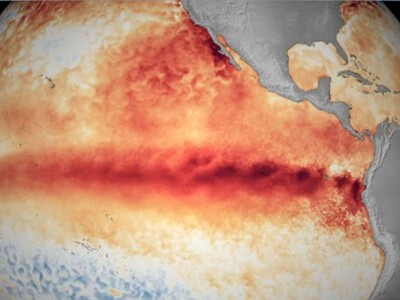
El Niño Could Reach Strong Intensity in 2026, Forecasters Warn
Translated from Spanish, summarized and contextualized by DistantNews.
At a glance
News
Official statement
New plan
- The El Niño phenomenon is strengthening in the equatorial Pacific Ocean and may reach high intensity by late 2026, according to the International Research Center on El Niño Phenomenon (CIIFEN).
- Sea surface temperature anomalies in the equatorial Pacific intensified in July, exceeding normal levels by 2.5 to 5 degrees Celsius, indicating a growing ocean-atmosphere coupling.
- CIIFEN forecasts a 100% probability of El Niño conditions from September to November 2026, with a 69% chance of the event's magnitude surpassing historical records since 1950.
The El Niño phenomenon is intensifying in the equatorial Pacific Ocean, with projections indicating it could reach a very strong intensity in the latter months of 2026. The International Research Center on El Niño Phenomenon (CIIFEN) highlighted this in its August bulletin, noting that El Niño is part of the El Niño-Southern Oscillation (ENSO) climate pattern.
During July, warm sea surface temperature anomalies in the equatorial Pacific escalated, ranging from 2.5 to 5 degrees Celsius above normal. This warming, coupled with changes in atmospheric indicators like winds, signals a strengthening connection between the ocean and the atmosphere. These anomalies have also extended into the North Pacific and intensified off the coasts of Ecuador and Peru, impacting regional productivity.
CIIFEN's forecast for the September-November 2026 period predicts a 100% probability of El Niño conditions, which may persist into early 2027. Models suggest a 95% likelihood of the phenomenon reaching a very strong intensity between October and December. Furthermore, there is a 69% chance that the event's magnitude could exceed historical records documented since 1950.
While originating thousands of kilometers away in the Pacific, El Niño's effects can be felt globally. The warming of the Pacific alters tropical atmospheric circulation, potentially influencing wind patterns, temperature, and precipitation worldwide. However, the specific impacts vary by region, and the phenomenon's intensity does not solely determine the magnitude of local effects. For Central America and northern South America, precipitation maps for September-November suggest below-normal conditions, though direct confirmation for all regions remains pending.
DistantNews Editorial
Originally published by Diario Libre in Spanish. Translated, summarized, and contextualized by our editorial team with added local perspective. Read our editorial standards.
More Stories



From Our Blog

What Gets Lost (and Found) When News Is Translated

The Critical Role of Diaspora Media in Global News

What Travellers Should Know About Countries with Restricted Press

A Digital Nomad's Guide to Following Local News

How the Same Story Looks Different in Different Countries
