


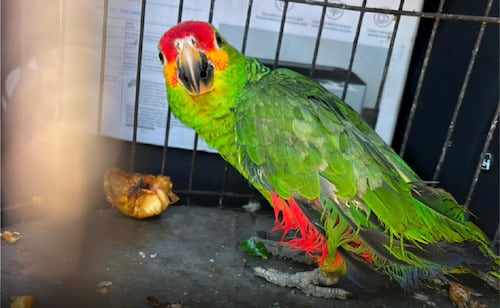
Endangered Parrots Seized in San Luis Potosí Home
Translated from Spanish, summarized and contextualized by DistantNews.
At a glance
News
Official statement
Outcome reported
- Authorities in San Luis Potosí, Mexico, seized two parrots, a lilac-crowned parrot and a yellow-cheeked parrot, found in a private residence.
- Both species are listed as endangered and their commercialization is prohibited under Mexican law.
- The seizure is part of a campaign to combat illegal wildlife trafficking, emphasizing the public's role in protecting biodiversity.
Environmental authorities in San Luis Potosí, Mexico, have successfully seized two endangered parrots from a private home following a citizen report. The operation by the Federal Attorney for Environmental Protection (Profepa) involved the confiscation of a lilac-crowned parrot and a yellow-cheeked parrot, both species facing significant threats to their survival.
The intervention stemmed from a public tip alerting authorities to the presence of the birds. Profepa, led by Mariana Boy Tamborrell, highlighted the crucial role of citizen participation in safeguarding biodiversity. Under the campaign hashtag "#TuCasaNoEsSuCasa" (Your Home Is Not Their Home), the agency urged the public not to keep endangered species.
Profepa officials conducted an inspection at the reported address, leading to the secure transfer of the parrots to an authorized Wildlife Management Facility (PIMVS). These facilities are designated spaces for the care and breeding of wild animals outside their natural habitats.
Both the lilac-crowned parrot and the yellow-cheeked parrot are officially recognized as endangered, listed in the NOM-059-SEMARNAT-2010 regulation. Profepa notes that all 22 species of Mexican parrots are considered endangered, making their extraction, sale, and possession illegal under Mexican law. The agency pointed out that the birds' ability to mimic speech, their perceived friendliness, and their beauty unfortunately make them prime targets for illegal trafficking.
In 2025, Profepa estimated that between 34,000 and 41,500 psittacine birds were illegally captured annually in Mexico, with a high mortality rate. The agency reported that seven out of every ten birds die before reaching their final destination. Article 60 Bis2 of the General Wildlife Law strictly prohibits the commercial exploitation of parrots and macaws native to Mexico. Authorizations for extractive use are limited to conservation or research purposes and are only granted to accredited academic institutions.
citizen participation is fundamental to protecting our biodiversity
DistantNews Editorial
Originally published by El Universal in Spanish. Translated, summarized, and contextualized by our editorial team with added local perspective. Read our editorial standards.
More Stories



From Our Blog

What Press Freedom Means for the News You Read

What Gets Lost (and Found) When News Is Translated

The Critical Role of Diaspora Media in Global News

What Travellers Should Know About Countries with Restricted Press

A Digital Nomad's Guide to Following Local News
