


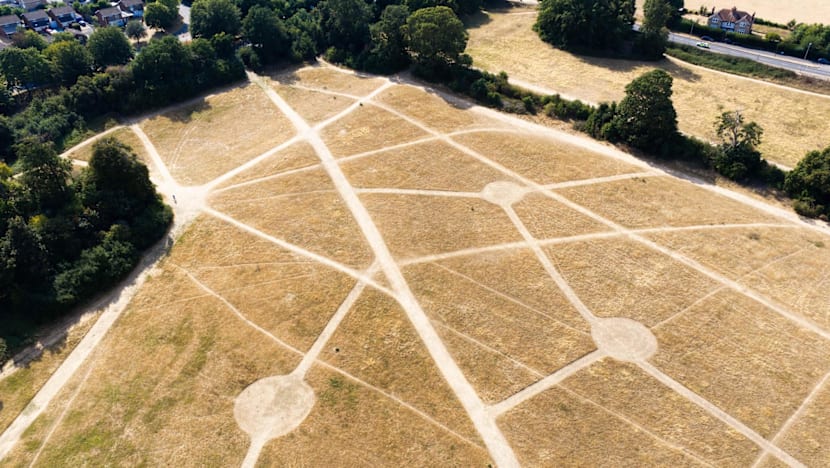
England, Wales had driest July on record: Met Office
Summarized and contextualized by DistantNews.
At a glance
News
Sources not specified
Context piece
- England and Wales recorded their driest July on record in 2026, according to the Met Office.
- The month was also Britain's sunniest ever observed, with exceptionally low rainfall and high sunshine hours.
- The dry conditions are impacting farmers, wildlife, and water availability, prompting calls for better adaptation to extreme weather.
England and Wales endured the driest July on record in 2026, the UK Met Office weather agency reported Monday, citing provisional figures. The month also stands as Britain's sunniest ever observed, characterized by a remarkable combination of record-breaking dryness, exceptional warmth, and unprecedented sunshine.
July 2026 has been a truly remarkable month in the UK's climate record.
England received only 10 percent of its average July rainfall, measuring just 6.5 millimeters (0.25 inches). Wales recorded 9.3 mm. In southern England, July was the driest month since records began in 1836, with a mere 1.9 mm of rainfall, or three percent of the average. Nineteen English regions, including London and its suburbs, experienced no more than one millimeter of rain last month.
It saw a "combination of record-breaking dryness, exceptional warmth and unprecedented sunshine."
These dry conditions follow three consecutive months with below-average rainfall. Helen Wakeham, chairperson of the National Drought Group, highlighted the severe effects on farmers, wildlife, and water resources for public and business use. Water companies in affected areas have implemented hosepipe bans. Greenpeace UK's head of politics, Ami McCarthy, described the impact on nature and biodiversity as "unfathomable," while Friends of the Earth's campaign head, Rosie Downes, urged for a stronger National Adaptation Plan to prepare for increasingly extreme weather events linked to global warming.
We are seeing the effects on our farmers, our wildlife, and the amount available for public and business use.
For the United Kingdom overall, July 2026 was the second-hottest July on record. This follows record-breaking heatwaves in May and June, which the UK Health Security Agency estimated caused 2,877 excess deaths. An amber health warning was issued for four regions, including London, due to increased risks for individuals over 65 or with pre-existing health conditions. Wales matched its joint hottest July on record, with a mean temperature of 17.8C, a figure previously recorded in 2006 and 1983.
The impact of this on nature and biodiversity - our birds, bees and butterflies - is simply unfathomable.
DistantNews Editorial
Originally published by CNA. Summarized and contextualized by our editorial team with added local perspective. Read our editorial standards.
More Stories


From Our Blog

What Gets Lost (and Found) When News Is Translated

The Critical Role of Diaspora Media in Global News

What Travellers Should Know About Countries with Restricted Press

A Digital Nomad's Guide to Following Local News

How the Same Story Looks Different in Different Countries
