


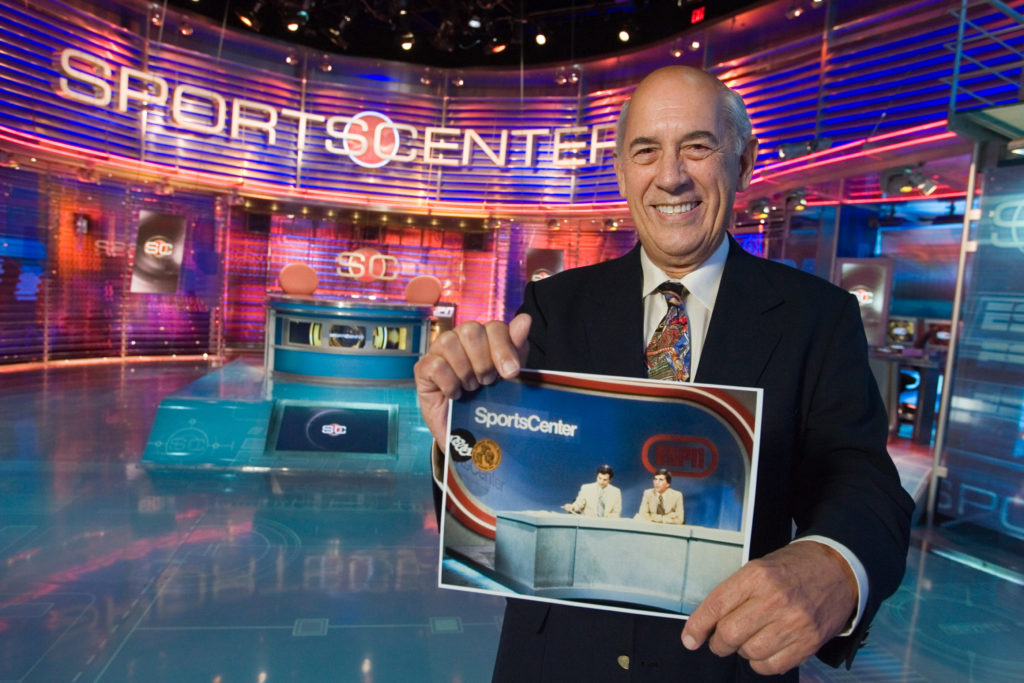
ESPN co-founder Bill Rasmussen dies at 93
Summarized and contextualized by DistantNews.
At a glance
News
From a news agency
Outcome reported
- Bill Rasmussen, co-founder of ESPN, died at age 93.
- He conceived the idea for the world's first all-sports cable network with his son.
- Rasmussen passed away at his Florida home due to complications from Parkinson's disease.
Bill Rasmussen, the visionary who co-founded the global sports broadcasting giant ESPN, died Tuesday at his Florida home. He was 93. ESPN historian Mike Soltys confirmed Rasmussen's death, attributing it to complications from Parkinson's disease, a condition he was diagnosed with in 2014.
Rasmussen conceived the groundbreaking idea for an all-sports cable network with his son, Scott. This innovative concept revolutionized sports television, offering round-the-clock sports coverage that transformed how Americans consumed sports content. Despite the network's eventual immense success, the Rasmussens were ousted from the company after just one year by its majority owner, Getty Oil.
Bill was a remarkable man, a visionary and an innovator who conceived the idea of a network entirely devoted to sports. Quite simply, none of us would be here today if it wasn't for Bill's passion and all the hard work and entrepreneurial spirit he put into building ESPN in the late 1970s, key aspects of our company culture that still carry on to this day.
ESPN launched on September 7, 1979, with George Grande hosting the inaugural "SportsCenter" broadcast. The network's first live event was a slow-pitch softball game. Initially, Rasmussen's vision was a more localized channel focusing on Connecticut sports. However, the idea evolved to reach a national audience via satellite, overcoming initial skepticism from cable operators.
In those days, we didn't know if we'd last four weeks, four years, let alone 40-some, but we knew it was special. Bottom line was Bill Rasmussen was the true purveyor of the original American dream, and he gave us all something very special that we still have today.
"Bill was a remarkable man, a visionary and an innovator who conceived the idea of a network entirely devoted to sports," said ESPN chairman Jimmy Pitaro in a statement. "Quite simply, none of us would be here today if it wasn't for Bill's passion and all the hard work and entrepreneurial spirit he put into building ESPN in the late 1970s, key aspects of our company culture that still carry on to this day."
ESPN's early years saw the introduction of programming like the NFL draft, the ESPY Awards in 1993, and the X Games competition in 1995. The network's influence significantly altered the landscape of college football, with games being scheduled to accommodate television audiences and a proliferation of postseason bowls.
When someone tells you you can't do something, you want to prove them wrong. Many, many people told us there wasn't enough sports to do a 24-hour channel. I didn't argue with anybody. I just thought they were wrong and I was right.
DistantNews Editorial
Originally published by PBS NewsHour. Summarized and contextualized by our editorial team with added local perspective. Read our editorial standards.
More Stories



From Our Blog

How the Same Story Looks Different in Different Countries

What Gets Lost (and Found) When News Is Translated

The Critical Role of Diaspora Media in Global News

What Travellers Should Know About Countries with Restricted Press

A Digital Nomad's Guide to Following Local News
