


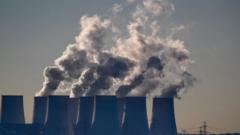
EU proposes slowing business carbon emissions cuts in climate policy overhaul
Translated from English, summarized and contextualized by DistantNews.
At a glance
News
Named sources
Ongoing story
- The EU has proposed slowing the pace of emissions cuts for businesses under its emissions trading system (ETS).
- Some industries could receive emission allowances until 2038 instead of 2034 if they invest in decarbonization.
- The proposals aim to align the ETS with the EU's goal of reducing emissions by 90% by 2040 but face approval from EU countries and lawmakers.
The European Union is proposing a significant overhaul of its climate policy, including a slowdown in emissions reduction targets for businesses. Under the proposed reforms, the bloc's emissions trading system (ETS) would relax rules, granting some industries emission allowances until 2038, an extension from the previously planned 2034 deadline, provided they commit to decarbonization investments.
We are adopting a more business-friendly and, may I say so, savvy approach
EU climate commissioner Wopke Hoekstra described the approach as "more business-friendly and, may I say so, savvy." The European Commission stated these changes would help align the ETS with the ambitious goal of reducing carbon emissions by 90% by 2040 compared to 1990 levels. The ETS, established in 2005, is the EU's primary tool for controlling greenhouse gases, though it has faced criticism, particularly from Italy, which views it as a de facto tax that inflates energy prices.
For the first time, we are seeing a softening of the stance rather than a toughening of it - this is a huge success for Poland. Although we will fight for more
The proposed changes include slowing the annual cap reduction rate to around 3.7% from 2031 and then to 1.7% from 2036, down from the current 4.3%. Free permits could continue until 2038, with companies investing in decarbonization receiving 80% upfront and the remaining 20% upon investment completion. However, the proposals require approval from EU countries and lawmakers, a process that could take a year. Poland's climate minister signaled a desire for further weakening, while German Green politician Michael Bloss criticized the plans, warning of "gigantic climate pollution" and a worse quality of life for future generations.
gigantic climate pollution
DistantNews Editorial
Originally published by BBC News in English. Translated, summarized, and contextualized by our editorial team with added local perspective. Read our editorial standards.
More Stories



From Our Blog

What Gets Lost (and Found) When News Is Translated

The Critical Role of Diaspora Media in Global News

What Travellers Should Know About Countries with Restricted Press

A Digital Nomad's Guide to Following Local News

How the Same Story Looks Different in Different Countries
