


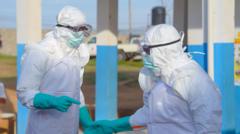
Fall in official Ebola numbers appears to be good news but it's not that simple
Summarized and contextualized by DistantNews.
At a glance
News
Named sources
Ongoing story
- Ebola case numbers in DR Congo and Uganda have been significantly reduced, but this reflects improved data rather than a lessened danger.
- Contact tracing remains a major challenge, with only about 45% of contacts being followed up due to conflict in the outbreak's epicenter and community mistrust.
- The current outbreak involves a rarer species of Ebola with no existing vaccine or proven treatment, complicating response efforts.
The latest Ebola figures from the Democratic Republic of Congo and neighboring Uganda suggest a hopeful decline, but officials caution against premature optimism. While authorities now report around 380 confirmed cases in DR Congo, including 60 deaths, and 15 confirmed cases with one death in Uganda, this reduction is attributed to better diagnostic data rather than a diminished threat.
the outbreak had a "big head start" but response teams are now "catching up".
Previously, figures included many suspected cases that laboratories have since ruled out, identifying other common illnesses like malaria. The World Health Organization (WHO) acknowledges the outbreak had a "big head start" but states response teams are "catching up." However, significant hurdles persist.
Contact tracing, crucial for controlling outbreaks, is hampered by conflict in the outbreak's epicenter, with only about 45% of contacts currently being monitored. The WHO emphasizes that at least 90% of contacts must be traced for effective control. Furthermore, mistrust within some communities poses a serious challenge, evidenced by a recent attack on an Ebola burial team in South Kivu province. Traditional burial practices, involving close contact with the deceased and large gatherings, are high-risk activities for Ebola transmission.
building trust with communities was critical to bringing the outbreak under control.
This outbreak is caused by the rarer Bundibugyo species of Ebola, for which no vaccine or proven treatment currently exists, although development efforts are underway. WHO Director-General Dr. Tedros Adhanom Ghebreyesus stressed the critical need to build trust with communities to contain the virus, highlighting that the COVID-19 pandemic resulted in far more deaths than recent conflicts.
the Covid pandemic had resulted in around 20 million deaths - far more than any recent conflict.
DistantNews Editorial
Originally published by BBC News. Summarized and contextualized by our editorial team with added local perspective. Read our editorial standards.
More Stories



From Our Blog

What Gets Lost (and Found) When News Is Translated

The Critical Role of Diaspora Media in Global News

What Travellers Should Know About Countries with Restricted Press

A Digital Nomad's Guide to Following Local News

How the Same Story Looks Different in Different Countries
