

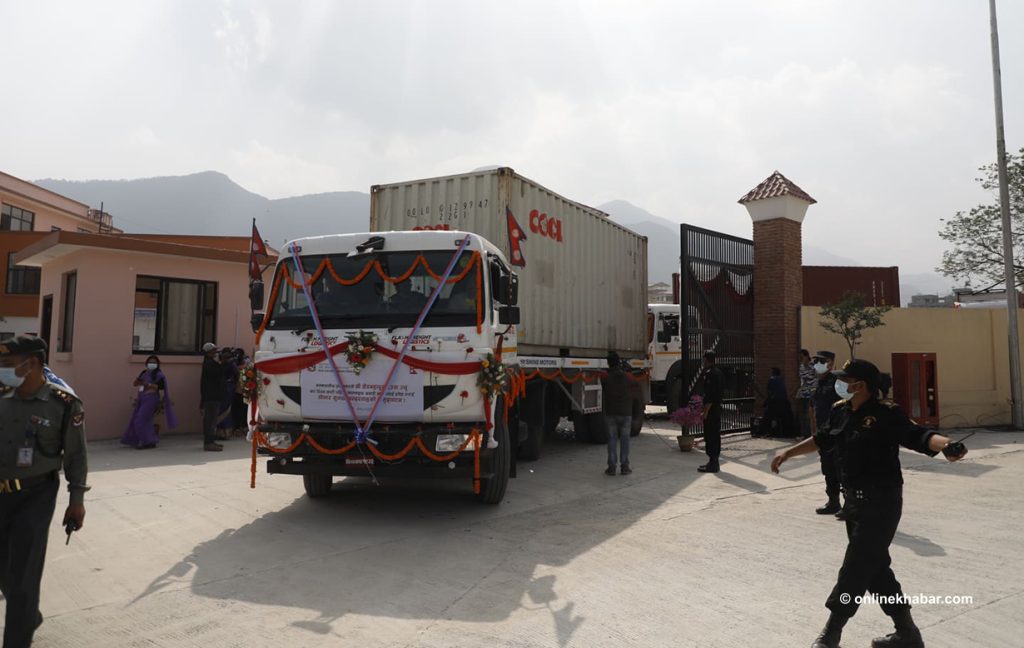

Farmers scramble for fertiliser as paddy planting season begins amid shortages
Summarized by DistantNews. Read the original for the full story.
At a glance
News
Sources not specified
Context piece
- Farmers in Nepal are facing severe shortages of essential fertilizers as the paddy planting season begins, threatening crop yields and household incomes.
- Despite government assurances, the available stock of urea, DAP, and potash is insufficient, forcing farmers to queue for hours and pay high prices for limited supplies.
- The lack of fertilizer, coupled with issues like drought and inadequate irrigation, exacerbates the struggles of farmers like Maharaja Yadav, who depend on their harvest for survival and education expenses.
Maharaja Yadav, a farmer from Narainapur Rural Municipality in Banke, Nepal, relies on her five kattha (0.17 hectares) of farmland to feed her family of six for an entire year. The harvest also covers daily expenses, children's education, and other needs. However, a prolonged drought two years ago, exacerbated by a lack of irrigation, devastated her crops and left her struggling to repay loans.
We somehow managed food for ourselves, but paying for the children’s education became very difficult. If we could get good seeds, fertiliser and timely irrigation, the harvest would improve and our family could survive.
As the current planting season approaches, Yadav's concerns extend beyond drought to the critical shortage of fertilizer. She notes that obtaining fertilizer has always been difficult during peak seasons, and market prices are prohibitively high. "Even after standing in line for hours, we don’t get enough fertiliser," Yadav said. "Without fertiliser, production falls. If there is no production, we cannot even recover our investment."
Even after standing in line for hours, we don’t get enough fertiliser. Without fertiliser, production falls. If there is no production, we cannot even recover our investment.
Farmers across Narainapur echo these sentiments, lamenting years of struggle with insufficient fertilizer, seeds, and irrigation during the crucial paddy planting season. Pushpa Raj Shrestha, manager of the Nepalgunj branch of the Agriculture Inputs Company Limited, confirmed that the current stock of 507 tonnes of urea, 484 tonnes of DAP, and 10 tonnes of potash is inadequate for the upcoming June-August paddy transplantation season.
Sometimes there is drought, and sometimes fertiliser is unavailable when needed most. Our hard work is going to waste.
In Bardiya, Saeed Ahmad Shesh, who cultivates 10 bigha (6.77 hectares) with his brother, is also desperately seeking fertilizer. He has been visiting cooperatives daily for a week, concerned that it is already too late to prepare the seedbed. "We have neither irrigation water nor fertiliser," he stated. "Without water and fertiliser, we cannot sow seeds." Shesh highlighted that while seeds can be purchased from agro-vets, fertilizer remains a persistent problem, with government-subsidized supplies through cooperatives limited to one sack per member, insufficient for larger landholdings.
It is already getting late to prepare the seed bed. We have neither irrigation water nor fertiliser. Without water and fertiliser, we cannot sow seeds.
About this summary
Originally published by Kathmandu Post. Summarized and contextualized automatically by DistantNews, with a note on how the source frames the story. Not individually reviewed before publishing. How this works.
More Stories

From Our Blog

News in Translation: What Gets Lost, and How We Keep the Framing

Diaspora Media: How Communities Abroad Follow Home

Traveling Where the Press Is Not Free: How to Read the News There

The Digital Nomad's Guide to Local News

The Same Story, Different Countries: How Coverage Changes at the Border
