


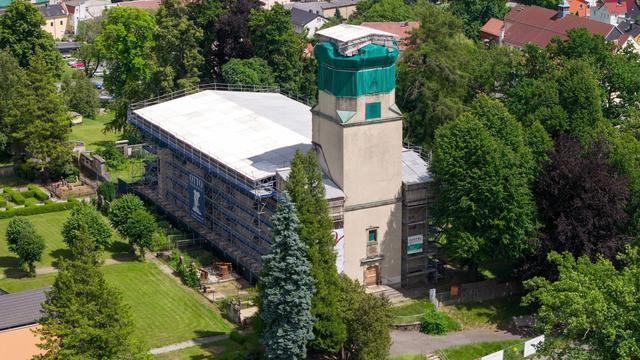
Fewer members and less money: Evangelical Regional Church halts construction projects for two years
Translated from German, summarized and contextualized by DistantNews.
At a glance
News
Named sources
New plan
- The Evangelical Regional Church of Saxony (EVLKS) is implementing a two-year construction moratorium.
- The church aims to reduce its building stock and focus on financially sustainable, essential structures.
- The moratorium exempts already approved projects, emergency repairs, and ongoing maintenance.
The Evangelical Regional Church of Saxony (EVLKS) has announced a two-year moratorium on new construction projects across its parishes. This decision aims to address the church's declining resources and membership by re-evaluating its extensive property portfolio.
The church wants to focus in the future on 'buildings that are absolutely necessary for maintaining church life and fulfilling the proclamation mandate and are financially sustainable.'
During this period, the EVLKS will focus on revising its building guidelines and concepts to reduce the overall "building burden." The goal is to concentrate investments on structures deemed essential for maintaining church life and fulfilling its mission, while ensuring financial viability. A directive outlining this plan was already sent to parishes and districts in April.
The moratorium, set to take effect in the latter half of the year, will exclude projects that have already received approval, as well as necessary emergency repairs and routine maintenance. The church currently manages approximately 4,450 buildings, including around 1,630 churches, chapels, parsonages, community centers, and educational facilities.
It cannot stay the same with our church buildings in terms of number and usage in the future.
Superintendent Sven Petry of the Leisnig-Oschatz district acknowledged that while the buildings are generally in good condition, the current scale of church properties and their usage cannot be sustained. He emphasized that decisions about church buildings are not purely economic, as they serve as points of identification and community gathering. The church faces the challenge of deciding whether to proactively manage this reduction or let it occur organically.
The decision for or against a church building is not purely an economic one.
DistantNews Editorial
Originally published by Die Zeit in German. Translated, summarized, and contextualized by our editorial team with added local perspective. Read our editorial standards.
More Stories



From Our Blog

What Gets Lost (and Found) When News Is Translated

How the Same Story Looks Different in Different Countries

The Critical Role of Diaspora Media in Global News

What Travellers Should Know About Countries with Restricted Press

A Digital Nomad's Guide to Following Local News
