


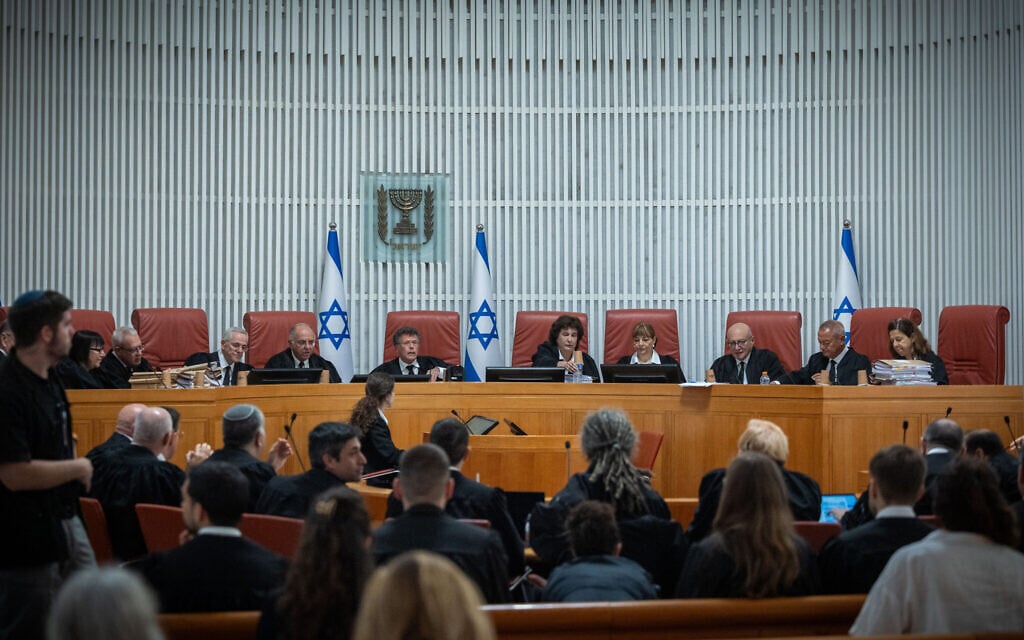
Fiercely critical High Court seems poised to annul keystone judicial overhaul law
Summarized and contextualized by DistantNews.
At a glance
Analysis
Named sources
Under investigation
- Israel's High Court of Justice is hearing arguments on legislation that would significantly increase political control over judicial appointments.
- Justices across the ideological spectrum have strongly criticized the government's reform, suggesting it is poised to be annulled.
- The government argues the reform aims to increase political diversity, while critics fear it will politicize the judiciary and undermine its independence.
The Israeli High Court of Justice on Sunday appeared poised to strike down a cornerstone of the government's judicial overhaul, as justices from across the political spectrum fiercely assailed the legislation designed to increase political influence over judicial appointments. The hearing, which focused on a law set to take effect after the upcoming election, saw numerous justices use strong language, describing the measure in "dystopian hues" and likening the proceedings to a "roasting of the government's lawyers."
The legislation grants politicians unprecedented veto power over lower court appointments and complete control over Supreme Court selections. In some instances, politicians could potentially handpick Supreme Court judges without a committee vote. Several justices expressed personal offense at the government's justification that the reform aims to increase "political diversity" on the bench, emphasizing that their political leanings are irrelevant to their professional conduct.
The ferocity of the justices' critique suggests a likely ruling against the government. This potential annulment is significant because the judicial reform is a central pillar of the current administration's agenda to limit the judiciary's power to check executive authority. The controversy is further compounded by the fact that the law was passed as an amendment to a quasi-constitutional Basic Law: The Judiciary.
While the government and its supporters argue that the court's authority for judicial review stems from Basic Laws, thus limiting the court's power to review them, at least five of the 11 justices hearing the case have previously ruled to strike down government actions based on Basic Laws. This precedent indicates a potential willingness to assert judicial authority over the government's legislative agenda, setting the stage for a highly contentious legal and political battle.
DistantNews Editorial
Originally published by Times of Israel. Summarized and contextualized by our editorial team with added local perspective. Read our editorial standards.
More Stories



From Our Blog

What Gets Lost (and Found) When News Is Translated

The Critical Role of Diaspora Media in Global News

What Travellers Should Know About Countries with Restricted Press

A Digital Nomad's Guide to Following Local News

How the Same Story Looks Different in Different Countries
