


FIFA's Private Investment Plan Sparks Controversy; African Silence Fuels Dependence Fears
Translated from French, summarized and contextualized by DistantNews.
At a glance
Analysis
Sources not specified
Context piece
- FIFA President Gianni Infantino's private investment project was met with strong opposition from European, South American, and Asian football federations.
- The project aimed to introduce private capital into FIFA, raising concerns about the potential commodification of football.
- African football confederations remained notably silent, fueling speculation about their alignment with FIFA's leadership.
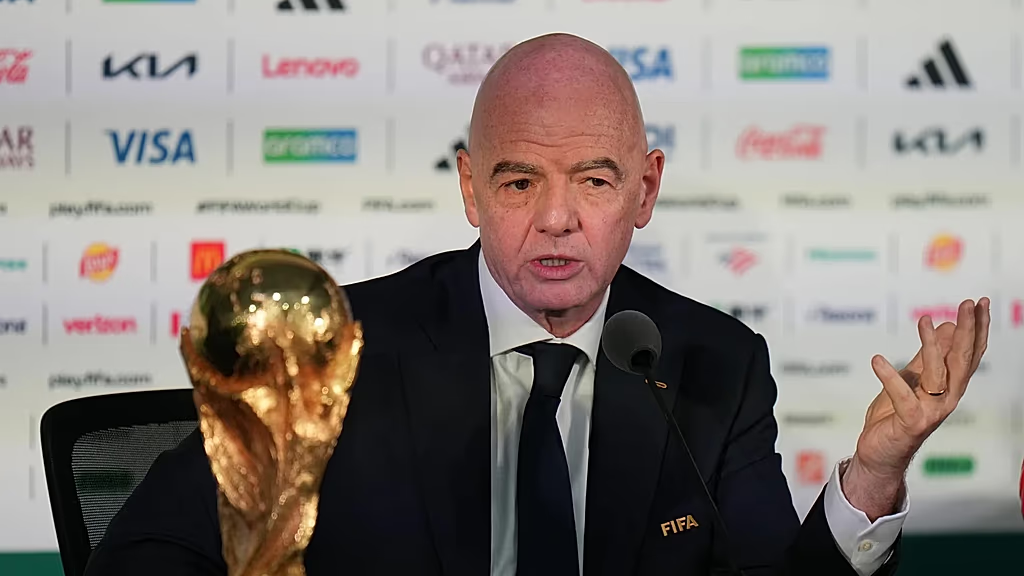
FIFA President Gianni Infantino's ambitious plan to introduce a significant private investment project into global football faced a strong backlash, narrowly avoiding what is described as one of the most dangerous threats to the sport's recent history. The initiative, intended to bring substantial private capital into the organization, sparked fears that it would fundamentally alter football's nature, potentially transforming the sport into a mere financial asset.
Critics argued that Infantino's proposal risked blurring the lines between football as a sport and football as a market. While acknowledging the substantial costs associated with modern football, including infrastructure, development, and competitions, opponents worried that prioritizing financial interests over the sport's intrinsic values would undermine its integrity. The concern was that money would cease to be a means to an end and instead become the ultimate goal, with the ball bouncing to the rhythm of financial interests rather than sporting ones.
European, South American, and Asian football federations united to block the "offensive," acting as a "last line of defense" against what they perceived as an attempt to list football on the stock exchange. Faced with this unified resistance, Infantino was compelled to shelve his project. In stark contrast, the Confederation of African Football (CAF) maintained a conspicuous silence throughout the controversy. This lack of public stance has fueled speculation, rightly or wrongly, about the confederation's potential complicity or undue closeness to FIFA's leadership.
While other confederations actively defended collective interests, Africa's perceived inaction has reinforced notions of a problematic relationship between some of its leaders and FIFA headquarters in Zurich. This situation raises a critical question: how far can football pursue financial gain before losing its soul? The danger is no longer solely corruption or match-fixing, but the "cult of the god of Money," which threatens to cross the decisive line between financing and commodifying the sport. If financial logic were to dictate schedules, competition formats, or even game outcomes, football would cease to belong to players and fans, becoming solely the domain of shareholders.
The danger is now the cult of the god of Money, ready to cross the border, as invisible as it is decisive, that separates the financing of football from its commodification.
DistantNews Editorial
Originally published by Le Pays in French. Translated, summarized, and contextualized by our editorial team with added local perspective. Read our editorial standards.
More Stories
From Our Blog

What Gets Lost (and Found) When News Is Translated

The Critical Role of Diaspora Media in Global News

What Travellers Should Know About Countries with Restricted Press

A Digital Nomad's Guide to Following Local News

How the Same Story Looks Different in Different Countries
