


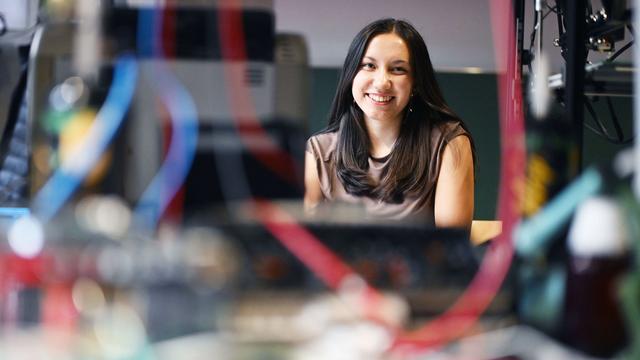
First student pioneers quantum computing studies in Germany
Translated from German, summarized and contextualized by DistantNews.
At a glance
News
From a news agency
New plan
- Jana Pohl enrolled as the first student in a unique bachelor's program in quantum computing at Karlsruhe University of Applied Sciences.
- The new program focuses on electrical engineering and computer science, with quantum mechanics introduced later, aiming to train specialists for a future technology with applications in medicine and AI.
- The university aims to provide practical training, differentiating it from master's programs, and is supported by industry experts who highlight the demand for such skills.
Jana Pohl, a 20-year-old, has become the first student to enroll in a pioneering bachelor's program in quantum computing at Karlsruhe University of Applied Sciences (HKA). The program, unique in the German-speaking world, aims to equip students with skills for a rapidly developing field.
I am preparing myself for it to be a bit more difficult.
Pohl, who previously studied business administration after a voluntary social year in Peru, was drawn to the quantum computing program by posters on campus. "It sounds more exciting, more challenging," she said, recalling her enjoyment of physics in school. The curriculum integrates electrical engineering and computer science, with quantum mechanics and quantum sensing introduced in later semesters.
It sounds more exciting, more challenging.
Quantum computers promise to solve complex problems faster than traditional machines through simulations, with potential applications ranging from drug development to artificial intelligence. The Fraunhofer Society cites examples like managing billions of payment flows or calculating price developments. Professor Philipp Nenninger, head of the program, emphasized its practical focus, stating, "We are training for what companies need right now." Pohl expressed particular enthusiasm for the laboratory components.
It fascinates me to study in an area where we can help shape things.
Natalia Stolyarchuk, head of Future Computing at the digital association Bitkom, noted the program addresses a critical need for practically trained specialists in quantum computing, a highly specialized field. While a bachelor's degree may suffice for applied tasks like quantum software development, advanced research often requires a master's or doctorate. The swift approval of the program, taking just 363 days, underscores political recognition of quantum computing's importance.
We are training for what companies need right now.
DistantNews Editorial
Originally published by Die Zeit in German. Translated, summarized, and contextualized by our editorial team with added local perspective. Read our editorial standards.
More Stories


From Our Blog

What Gets Lost (and Found) When News Is Translated

How the Same Story Looks Different in Different Countries

The Critical Role of Diaspora Media in Global News

What Travellers Should Know About Countries with Restricted Press

A Digital Nomad's Guide to Following Local News
