


Floods destroy 1,806 hectares of farmland and threaten food supplies
Translated from English and summarized by DistantNews. Read the original for the full story.
At a glance
News
Documents & data
Ongoing story
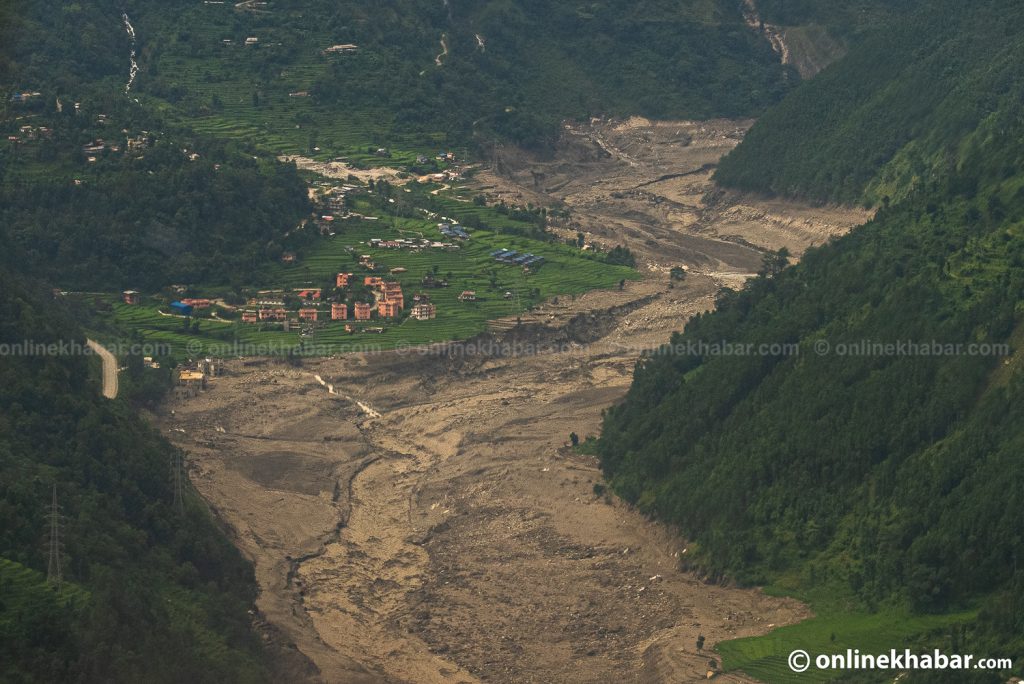
- Floods along Nepal’s Bhotekoshi corridor have damaged 1,806 hectares of agricultural land, according to a preliminary government assessment.
- Food production in affected areas is expected to fall by 7,686 tonnes, threatening local supplies during the main farming season.
- The flooding has also disrupted efforts to promote indigenous and climate-resilient crops in Nuwakot’s Bidur Municipality.
Farmers in Nepal’s Nuwakot district had spent two years adapting to a changing climate. In Bidur Municipality, they were growing paddy alongside millet and soybeans, while new equipment was being introduced to turn locally produced millet into bakery products.
That effort has been badly hit by the Bhotekoshi floods. Six farmers involved in the project have been missing, said Sudha Sapkota of the Nepal Agricultural Research Council. Other farmers have lost their fields and crops, and some no longer have farmland to cultivate.
Many farmers have lost their fields and crops, while some no longer have farmland to cultivate.
“Many farmers have lost their fields and crops, while some no longer have farmland to cultivate,” Sapkota said after returning from an inspection visit. “Farmers who were planning to start production and increase their income are now anxious and unsure about how to move forward.”
Farmers who were planning to start production and increase their income are now anxious and unsure about how to move forward.
Thirty farmers had received training through a collaboration between the Food and Agriculture Organisation and the National Agriculture Genetic Resources Centre, known as the gene bank. They had also received new paddy varieties, while machines and ovens had recently been distributed. Farmers were encouraged to expand climate-friendly varieties including Ram Dhan and Sabitri.
The floods destroyed paddy, soybeans and pulses planted along field boundaries. A preliminary assessment by Nepal’s National Disaster Risk Reduction and Management Authority found that 1,806 hectares of agricultural land had been damaged. Shanti Mahar, the authority’s spokesperson, said food production in affected areas was expected to decline by 7,686 tonnes. She stressed that the figures remain preliminary and will be updated after a full assessment.
The floods have severely affected farmers’ hopes of earning an income from their produce and have also affected local food consumption.
Sapkota said the damage had weakened both farmers’ prospects of earning income and local food consumption. Experts warn that losses during the main farming season will disrupt food supplies, while the destruction of fields undermines efforts to build more resilient local agriculture.
These figures are from the preliminary assessment.
About this summary
Originally published by Kathmandu Post in English. Translated, summarized, and contextualized automatically by DistantNews, with a note on how the source frames the story. Not individually reviewed before publishing. How this works.
More Stories


From Our Blog

News in Translation: What Gets Lost, and How We Keep the Framing

Diaspora Media: How Communities Follow News From Home

Traveling Where the Press Is Not Free: How to Read the News There

The Digital Nomad's Guide to Local News

The Same Story, Different Countries: How Coverage Changes at the Border
