


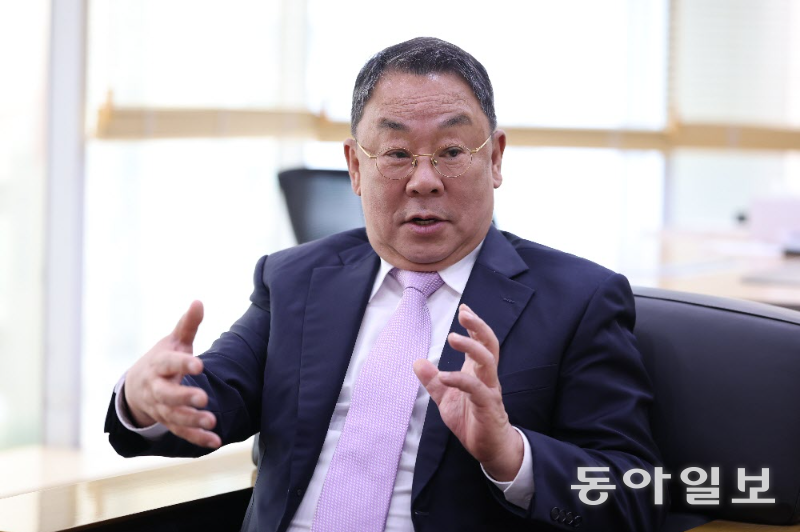
“Following Others Won't Ensure Competitiveness”… Hankuk Carbon Targets Aerospace and Space Materials
Translated from Korean, summarized and contextualized by DistantNews.
At a glance
Interview
Named sources
Context piece
- Hankuk Carbon Chairman Cho Moon-soo emphasizes the importance of developing future-oriented technologies over immediate profits.
- The company specializes in processing carbon and glass fibers for use in LNG carriers, aircraft, satellites, and launch vehicles.
- Hankuk Carbon aims to expand into aerospace, space, and defense materials as its next growth engine, having invested over 50 billion won since 2010.
Cho Moon-soo, chairman of Hankuk Carbon, believes that sustainable, future-oriented technology is more valuable than short-term profits. He advocates for companies to pioneer new paths rather than merely repeating what others are already doing. "It is important to make a lot of money, but it is more valuable to have technology that can be sustained in the future, not just immediate profits," Cho stated.
Hankuk Carbon is a mid-sized company that processes carbon and glass fibers. Its products serve as intermediate materials for various applications, including fishing rods, golf clubs, liquefied natural gas (LNG) carriers, aircraft, satellites, and launch vehicles. The company has established itself as a leader in the global market by localizing secondary barrier materials for LNG carriers, which are essential for transporting LNG at extremely low temperatures.
Cho explained that the secondary barrier requires complex technologies, including glass fiber weaving, resin impregnation, metal surface treatment, and pressing. While competitors often separate these processes, Hankuk Carbon has integrated them into a single production system. "Among the machines we built ourselves, there is not a single one that is the same as the previous machine," he noted, attributing the company's quality and price competitiveness to continuous investment in upgrading equipment and streamlining processes.
This strong technological foundation has translated into significant financial growth. Last year, Hankuk Carbon reported consolidated revenue of 908.8 billion won and an operating profit of 130.9 billion won, marking a 22.5% increase in revenue and a substantial 188.1% rise in operating profit compared to the previous year.
Looking ahead, Hankuk Carbon is focusing on aerospace, space, and defense materials as its next growth drivers. Since 2010, the company has invested over 50 billion won in production facilities and personnel for developing high-heat-resistant materials for aircraft structures, engines, satellites, and launch vehicles. Recently, an unmanned aerial vehicle developed in collaboration with the Agency for Defense Development, incorporating domestically produced materials, was delivered to Korean Air.
Cho also highlighted the "support cliff" phenomenon in South Korea, where companies face diminishing opportunities and support as they grow from small to medium-sized enterprises. He cited the offset trading system in defense exports as an example, where mid-sized companies receive less credit for purchasing Korean components or transferring technology compared to small and medium-sized enterprises, thus halving their profitability. "If the benefits are halved the moment you graduate from a small and medium-sized enterprise, who would want to grow into a mid-sized company?" he questioned, urging a solution to this "support cliff" issue.
DistantNews Editorial
Originally published by Dong-A Ilbo in Korean. Translated, summarized, and contextualized by our editorial team with added local perspective. Read our editorial standards.
More Stories



From Our Blog

What Gets Lost (and Found) When News Is Translated

The Critical Role of Diaspora Media in Global News

What Travellers Should Know About Countries with Restricted Press

A Digital Nomad's Guide to Following Local News

How the Same Story Looks Different in Different Countries
