


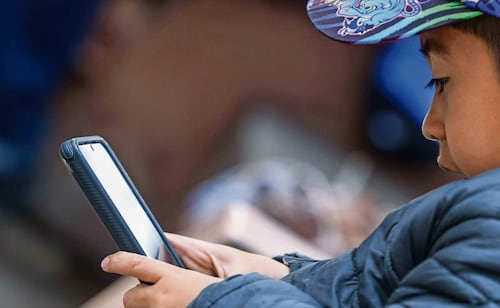
 Image: Especial
For 13.1 million Mexican minors, the cellphone is the only available technology, study finds gaps in SEP consultation
Translated from Spanish and summarized by DistantNews. Read the original for the full story.
At a glance
Analysis
Documents & data
Context piece
- An estimated 13.1 million Mexican children and teenagers aged 6 to 17 live in homes where a cellphone is the only available technology.
- The study says 60.5% of minors who use the internet connect exclusively by phone, while only 35.2% connect from school.
- Researchers say the Education Ministry's consultation on regulating devices does not ask whether schools have internet, equipment or storage space.
For 13.1 million children and teenagers in Mexico, the cellphone is the only technology available at home. That is the central finding of an analysis by the Tec de Monterrey's Initiative for Education with Equity and Quality and México Evalúa, based on 2025 national survey microdata.
The figures point to a sharp divide in how students access the internet. Nationally, 60.5% of internet users aged 6 to 17 connect only through a mobile phone, while just 35.2% can connect from school. The analysis says the dependence on phones grows as household conditions become poorer.
Among children in the lowest socioeconomic group, only 26.1% connect from their school, while 77% rely exclusively on a cellphone. Some 73.1% live in homes without a computer, laptop or tablet, equivalent to 4.2 million minors. In the lower-middle group, 64.4% depend only on a phone and 52.1% lack other devices at home, or about 7 million children.
The gap reverses among wealthier households. In the highest group, 57.2% connect from school, only 30% depend exclusively on a cellphone, and 11.2% lack a computer, laptop or tablet. Rural students also face weaker access than urban students: 28% connect at school in rural areas, compared with 37.3% in cities.
The analysis criticizes a consultation by Mexico's Public Education Secretariat on the support schools need to regulate devices. It says the consultation does not ask whether campuses have internet, their own equipment or places to store students' phones. "The school compensates less precisely where the household depends more on the cellphone," the document says.
The school compensates less precisely where the household depends more on the cellphone.
About this summary
Originally published by El Universal in Spanish. Translated, summarized, and contextualized automatically by DistantNews, with a note on how the source frames the story. Not individually reviewed before publishing. How this works.
More Stories


From Our Blog

What Press Freedom Means for the News You Read

What Gets Lost (and Found) When News Is Translated

The Critical Role of Diaspora Media in Global News

What Travellers Should Know About Countries with Restricted Press

A Digital Nomad's Guide to Following Local News
