


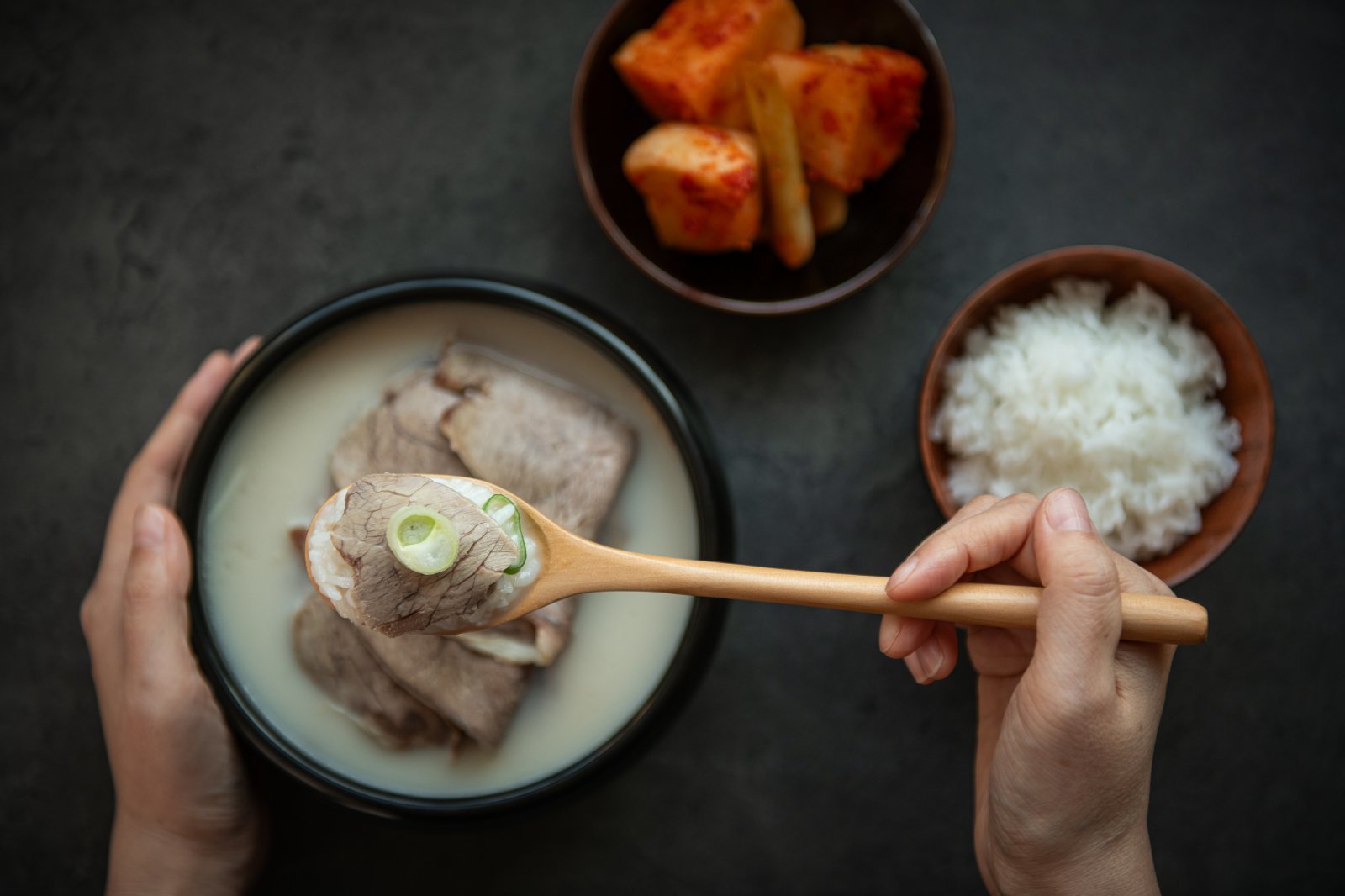
Foreign Media Highlights Korean Custom of Not Lifting Rice Bowls
Translated from Korean, summarized and contextualized by DistantNews.
At a glance
News
Named sources
Context piece
- A Korean dining custom of not lifting the rice bowl while eating has garnered international attention.
- Unlike Vietnamese, Chinese, and Japanese customs where bowls are often lifted, Koreans traditionally eat with the bowl placed on the table.
- This practice is linked to the use of spoons, the composition of meals, and the material of traditional tableware.
A traditional Korean dining etiquette, specifically, the practice of not lifting one's rice bowl while eating, has become a topic of discussion internationally, highlighted by foreign media. This custom contrasts sharply with dining habits in neighboring countries like Vietnam, China, and Japan, where lifting bowls is common.
Many Koreans were taught from childhood not to lift the rice bowl.
While diners in Vietnam and China typically hold their rice bowl with one hand and eat with the other, and Japanese diners frequently lift their rice or soup bowls, Koreans have historically been taught from a young age not to lift their rice bowls. Placing the bowl on the table and leaning over to eat is considered more polite in Korean culture. Other related customs include not sticking chopsticks vertically into rice or starting to eat before elders.
Several factors contribute to this distinct practice. The widespread use of spoons in Korea, unlike the predominant use of chopsticks in China and Japan, allows individuals to eat rice without lifting the bowl. Historically, Korea's environment was less suited for wheat cultivation, leading to a continued emphasis on rice as a staple, thus maintaining the spoon-centric eating style. Furthermore, the material of traditional Korean tableware, such as brass bowls (made of 78% copper and 22% tin), had high thermal conductivity. This meant bowls became too hot to hold when filled with hot food, reinforcing the practice of keeping them on the table.
Because of the habit of eating with a spoon, the act of lifting the rice bowl came to be considered impolite.
However, the article notes that these rules are not absolute. Dining customs can vary based on the type of food and the situation in Vietnam, China, and Japan. Similarly, modern Koreans may occasionally lift smaller bowls during casual meals, and the rules tend to be more flexible when eating noodle dishes or fast food.
In the past, the ruling classes in Korea and China ate both rice and soup with spoons, but from around the 7th century, as noodles and flour-based foods became the staple in northern China, the use of chopsticks gradually became dominant.
DistantNews Editorial
Originally published by Dong-A Ilbo in Korean. Translated, summarized, and contextualized by our editorial team with added local perspective. Read our editorial standards.
More Stories


From Our Blog

What Gets Lost (and Found) When News Is Translated

The Critical Role of Diaspora Media in Global News

What Travellers Should Know About Countries with Restricted Press

A Digital Nomad's Guide to Following Local News

How the Same Story Looks Different in Different Countries
