


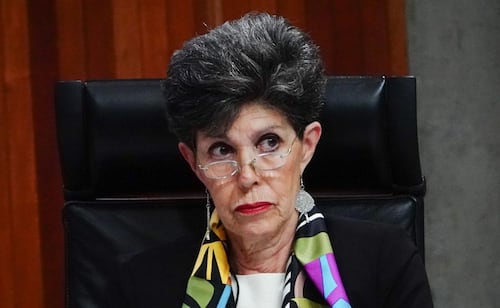
 Image: Rogelio Morales/ Cuartoscuro
Former Electoral Tribunal President Denounces Fraud in Morena's Coordinator Elections
Translated from Spanish and summarized by DistantNews. Read the original for the full story.
At a glance
News
Sources not specified
Context piece
- Former TEPJF President Janine Otálora alleges that the Superior Chamber validated early electoral processes, such as Morena's "coordinators of the defense of the transformation" elections, through legal fraud.
- Otálora stated that electoral authorities show "total apathy" towards regulating or prohibiting these advanced processes, contributing to citizen distrust.
- She argued that the tribunal's reasoning that these processes are not electoral is a fallacy, as participants had already declared presidential ambitions.
Janine Otálora Malassis, former president of Mexico's Electoral Tribunal of the Federal Judicial Power (TEPJF), has denounced what she terms a "fraud against the law" in the recent election of Morena's "coordinators of the defense of the transformation." She accuses the TEPJF's Superior Chamber of validating premature electoral processes, including similar ones in the PAN and PRI, through "functional equivalents." Otálora argues this creates a parallel legal reality, fostering misinformation and eroding citizen confidence.
Speaking at a seminar on the "2026-2027 Electoral Process: Conditions for Fair Competition" at UNAM's Institute of Legal Research, the retired magistrate expressed regret over the current situation. She noted that Morena is already announcing its pre-candidates for governorships in 2027. While acknowledging some "lukewarm" attempts by National Electoral Institute (INE) counselors to regulate or prohibit these early activities, Otálora highlighted a "total apathy" from electoral authorities.
Otálora questioned the integrity of a democracy where legal truth is manipulated by a constitutional court with the final say in electoral matters. She recalled that for the 2024 election, Morena engaged in illegal pre-campaigning for two months. When complaints were filed with the TEPJF, the Superior Chamber ruled that these actions did not affect the principles of legality or fairness.
"This is an extremely serious argument," Otálora warned. She pointed out that the chamber's majority rulings stated that these coordinator selection processes were not electoral. However, she countered that this premise is flawed because those who registered for these processes had already publicly expressed their intention to seek the presidency. The TEPJF's own sentences suggest these elections are not illegal as long as campaign activities are avoided, yet such activities are demonstrably occurring in reality. Otálora concluded that these rulings represent a "legal artifice or trick" and that the Superior Chamber's claim of dynamic law and changing constitutional parameters based on context is a dangerous justification.
About this summary
Originally published by El Universal in Spanish. Translated, summarized, and contextualized automatically by DistantNews, with a note on how the source frames the story. Not individually reviewed before publishing. How this works.
More Stories

From Our Blog

What Press Freedom Means for the News You Read

What Gets Lost (and Found) When News Is Translated

The Critical Role of Diaspora Media in Global News

What Travellers Should Know About Countries with Restricted Press

A Digital Nomad's Guide to Following Local News
