


Former KPK Investigator: Returning Money Does Not Erase Criminal Liability in Bribery Case
Translated from Indonesian, summarized and contextualized by DistantNews.
At a glance
News
Named sources
Under investigation
- A former Corruption Eradication Commission (KPK) investigator stated that returning money does not erase criminal liability in bribery cases.
- The former investigator questioned the timing and motive behind a minister's recent report of receiving a bribe, especially after an arrest.
- He emphasized that bribery cases cannot be disguised as mere gratification, and KPK regulations prevent using gratification reports to avoid criminal proceedings.
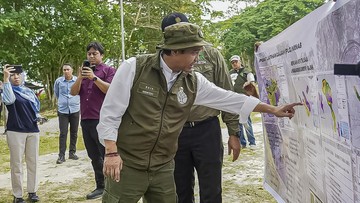
A former investigator for Indonesia's Corruption Eradication Commission (KPK) has asserted that returning money, even in cases of alleged bribery or gratuity, does not absolve individuals of criminal responsibility. Mochamad Praswad Nugraha, speaking on a case involving the Minister of Forestry, Raja Juli Antoni, stated that the return of money in an envelope does not automatically nullify criminal charges.
Because of that, the event cannot be seen as ordinary gratuity, but has the characteristics of bribery because of the background and purpose of its provision.
Praswad highlighted a case concerning the release of limited production forest areas in Kuantan Singingi, Riau province. He believes there is a clear link between the money provided and the ongoing process of forest land release. "Therefore, the event cannot be seen as ordinary gratuity, but has the characteristics of bribery because of the background and purpose of its provision," Praswad explained.
In criminal bribery, the return of money is not a reason that erases criminal liability.
He further questioned the timing of Raja Juli Antoni's report to the KPK regarding the alleged gratuity, which was only made on July 3, after an arrest had occurred. Praswad pointed out that under KPK's gratification reporting mechanism, received items or money must be submitted for examination and status determination. If the money is returned to the giver before being reported, the process becomes irrelevant as the object is no longer in the reporter's possession.
Therefore, the reporting was only done after the OTT (Operation Catching Hand) occurred, so it is natural for the public to question why the reporting was not done from the beginning of receipt.
Praswad, who also heads the Southeast Asia Anti-Corruption Syndicate (SEA Actions), stressed that if an event shows signs of being a bribery case, the gratification reporting mechanism cannot be used to alter its character. This aligns with KPK Regulation No. 1 of 2026, which states that gratification reports are not pursued if a criminal investigation is already underway or if the report is suspected to be related to a criminal act. In such circumstances, the KPK forwards the information to the relevant authorities for legal processing.
Thus, the reporting of gratuity cannot be used as an instrument to change alleged bribery into a mere gratification case or to avoid criminal proceedings.
DistantNews Editorial
Originally published by CNN Indonesia in Indonesian. Translated, summarized, and contextualized by our editorial team with added local perspective. Read our editorial standards.
More Stories


From Our Blog

What Gets Lost (and Found) When News Is Translated

The Critical Role of Diaspora Media in Global News

What Travellers Should Know About Countries with Restricted Press

A Digital Nomad's Guide to Following Local News

How the Same Story Looks Different in Different Countries
