


From Gallup Researcher to Law Graduate, Young Koreans Find New Paths as Farmers
Translated from Korean and summarized by DistantNews. Read the original for the full story.
At a glance
In-depth
Named sources
Context piece
- Young people from research, engineering, online commerce and law are starting farms after leaving urban careers.
- They use rented farms and skills from their previous jobs to reduce costs and apply data analysis, engineering and marketing to production.
- The farmers are expanding beyond raw produce through online sales, processing, branding and farm experiences.
A former data researcher at Gallup Korea now grows cucumbers in Asan, South Chungcheong Province. An engineer trained in mechanical and architectural engineering cultivates European lettuce and basil in Sacheon, South Gyeongsang Province, using hydroponic equipment he built himself. A law school graduate has moved to the countryside to grow organic mugwort.
The completion of farming is sales.
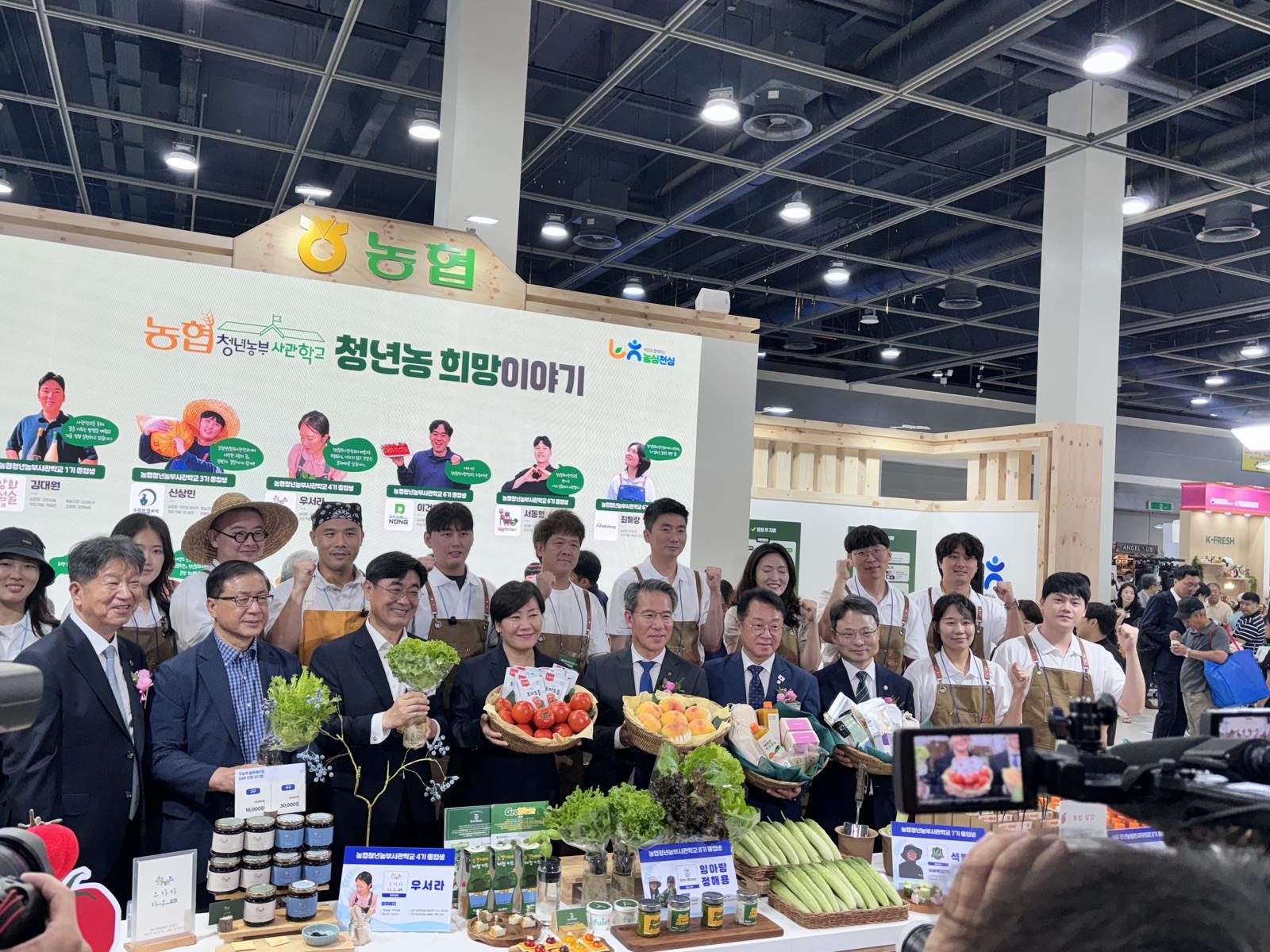
Their varied backgrounds were on display at the 2026 A Farm Show, a start-up and return-to-farming expo held at Seoul’s aT Center. Some young farmers inherited family operations, but many first entered agriculture after working in cities.
They share a view of farming as more than production. By starting on rented farms, they lower initial costs. They also apply expertise from previous careers to cultivation, then seek additional income through online sales, processing and branding.
I sometimes feel that selling is harder than farming.
Tomato grower Do Bobin, who runs Dopamin in Jangsu, North Jeolla Province, moved from an urban job to rural life. After completing tomato training at the 13th class of the Nonghyup Young Farmer Academy and gaining practical experience on a master farmer’s operation, Do began growing tomatoes in a smart farm at a leased training facility run by the Jangsu Agricultural Technology Center. The produce reaches customers through direct sales and auction markets.
What matters more is what kind of person I can become capable of being 10 years from now.
Woo Seora, who previously operated an online shopping mall, grows blueberries in Buan. She first learned cultivation because she felt she could not properly sell her father’s blueberries without understanding the crop. She now uses Smart Store, Nonghyup Mall and crowdfunding, while developing the brand and its visual identity. Other farmers featured at the event are pursuing similar models, including processed foods, consumer products and farm-based experiences.
Agriculture has more variables than I expected, including market-price fluctuations, and things do not always go according to plan.
About this summary
Originally published by Dong-A Ilbo in Korean. Translated, summarized, and contextualized automatically by DistantNews, with a note on how the source frames the story. Not individually reviewed before publishing. How this works.
More Stories


From Our Blog

What Gets Lost (and Found) When News Is Translated

The Critical Role of Diaspora Media in Global News

What Travellers Should Know About Countries with Restricted Press

A Digital Nomad's Guide to Following Local News

How the Same Story Looks Different in Different Countries
