


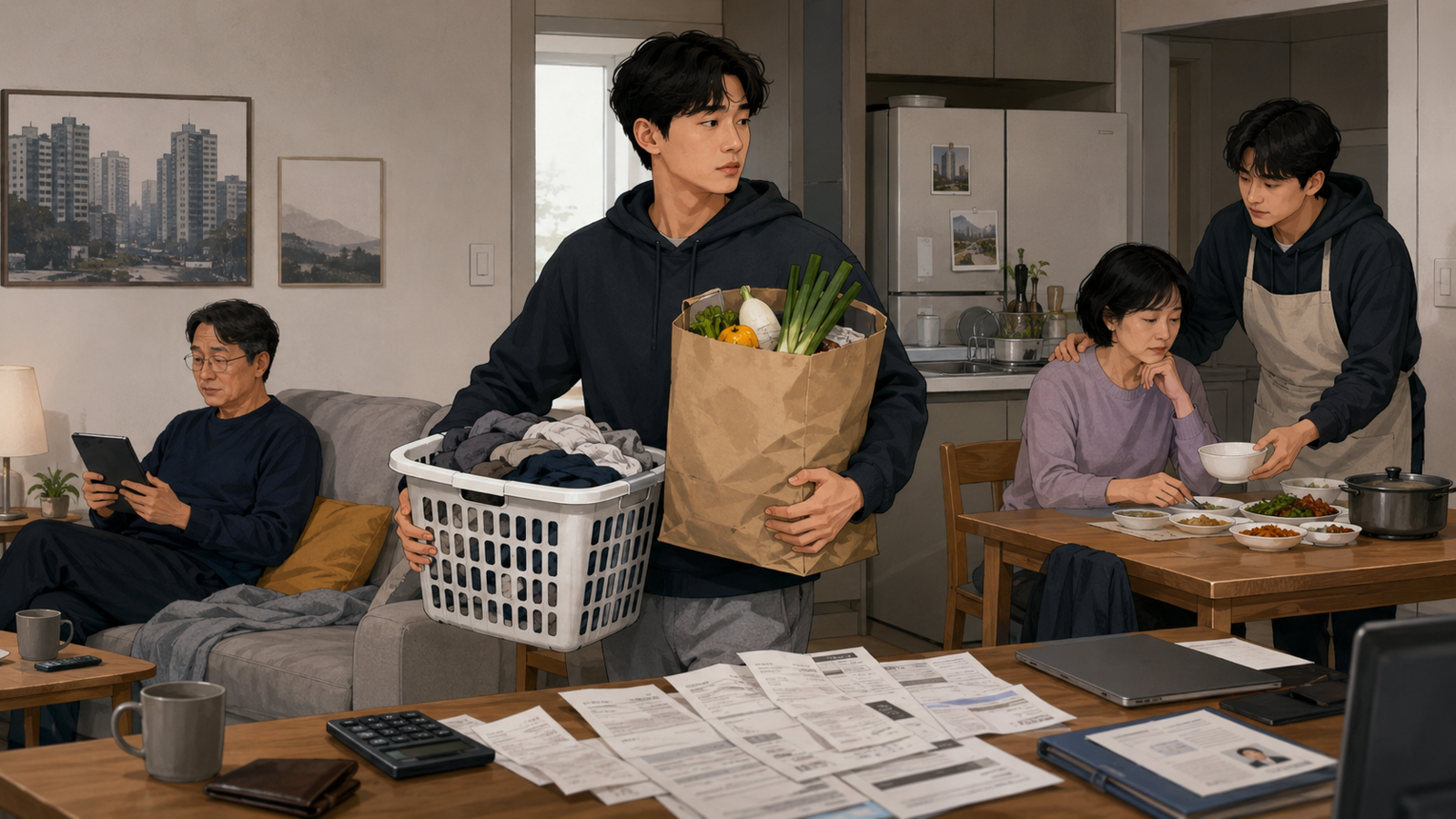
'Full-Time Children' Trend Grows in South Korea Amid Economic Hardship
Translated from Korean, summarized and contextualized by DistantNews.
At a glance
News
Named sources
Context piece
- A growing trend in South Korea sees young adults living with parents, taking on household chores and caregiving in exchange for financial support, termed 'full-time children'.
- This phenomenon, originating from China's 'quan zhi er nü' concept, reflects the challenges of high inflation and prolonged job scarcity impacting youth independence.
- Experts suggest this is a survival strategy driven by economic realities, urging societal adaptation and policy support rather than criticism.
A new family dynamic is emerging in South Korea, where young adults are opting to live with their parents, taking on domestic responsibilities and caregiving duties in exchange for financial support. Dubbed 'full-time children,' this trend mirrors a similar phenomenon in China and highlights the severe economic pressures facing the nation's youth.
The rise of 'full-time children' is an inevitable outcome of the era of low growth, high inflation, and youth unemployment.
The rise of 'full-time children' is closely linked to South Korea's persistent high inflation and a challenging job market. Official data shows a significant decrease in youth employment, with the youth employment rate falling by 2.4 percentage points year-on-year. Coupled with rising housing costs, these economic factors are delaying the age at which young people can achieve independent living.
Societal views on this trend are divided. Some view it as a practical survival strategy, enabling young adults to save on living expenses while preparing for employment. Others criticize it as a prolonged dependence on parents, potentially hindering personal growth and increasing the burden on aging parents. Experts, however, emphasize that this is a response to systemic economic issues.
Rather than criticizing or denying it, we should accept it as a new family form and consider institutional improvements to leverage its advantages and mitigate side effects.
Academics like Jeon Young-soo from Hanyang University's Graduate School of International Studies, author of a book on the subject, describe 'full-time children' as an inevitable outcome of low growth, high inflation, and youth unemployment. He advocates for societal acceptance and policy adjustments, such as tax reforms and welfare expansions, to support this new family structure and prevent feelings of relative deprivation among young adults.
Policies should include support measures such as tax reforms. From minimal tax neutrality for 'full-time children' to maximum welfare expansion, we need to reconsider.
DistantNews Editorial
Originally published by Dong-A Ilbo in Korean. Translated, summarized, and contextualized by our editorial team with added local perspective. Read our editorial standards.
More Stories



From Our Blog

What Gets Lost (and Found) When News Is Translated

The Critical Role of Diaspora Media in Global News

What Travellers Should Know About Countries with Restricted Press

A Digital Nomad's Guide to Following Local News

How the Same Story Looks Different in Different Countries
