


Georgia Republican leaders reject governor's call for redistricting session
Translated from English, summarized and contextualized by DistantNews.
At a glance
News
Named sources
Context piece
- Georgia's Republican legislative leaders rejected Gov. Brian Kemp's proposal to redraw congressional and legislative districts in a special session.
- They cited concerns about acting too quickly following a Supreme Court decision that weakened federal Voting Rights Act protections.
- Civil rights activists and Democrats celebrated the decision, viewing it as a victory against efforts to reduce minority voter representation.
Georgia's Republican legislative leaders have rebuffed Governor Brian Kemp's request to redraw congressional and legislative districts during a special session. The leaders cited concerns about the timing of such a move, particularly in the wake of a U.S. Supreme Court decision that weakened federal Voting Rights Act protections for minority voters.
The decision by State House Speaker Jon Burns and other leaders effectively halted an effort that critics argued aimed to reduce the representation of nonwhite voters. This contrasts with actions in other Southern states where Republican majorities moved swiftly to redraw congressional maps before the November elections, partly to bolster the GOP's House majority.
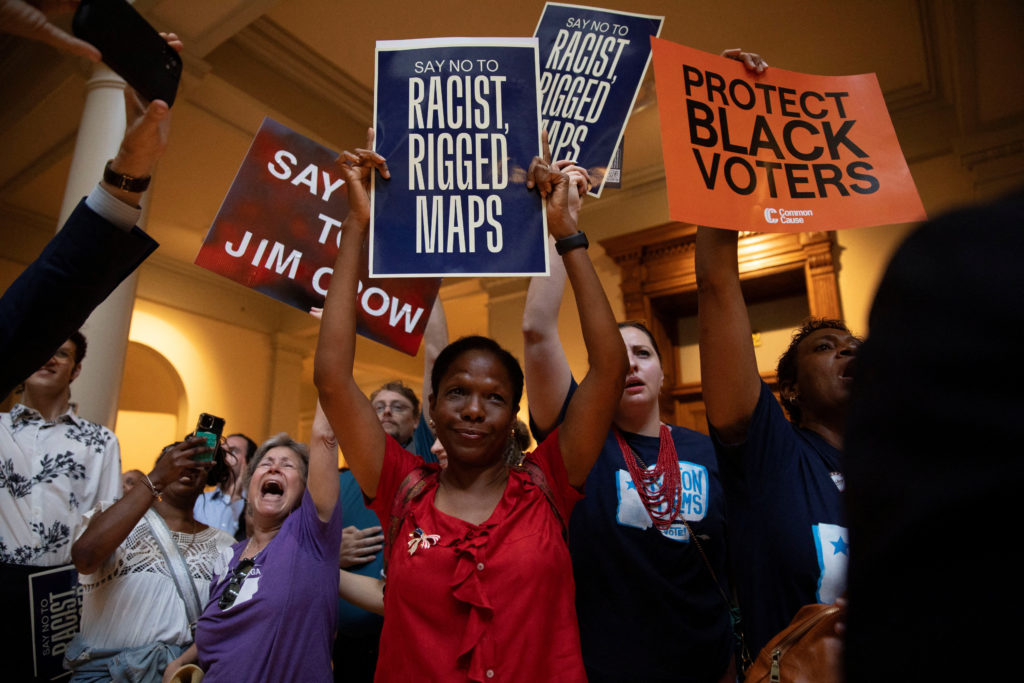
Civil rights activists and Democratic lawmakers, especially those from minority communities, hailed the legislative leaders' decision as a significant victory. They had exerted weeks of pressure and organized demonstrations at the Georgia Capitol, chanting "Black voters matter!" U.S. Senator Raphael Warnock, Georgia's first Black senator, who returned to Atlanta for the session, stated, "Today showed that ordinary people don't need to wait until November to make their voices heard and protect our democracy."
Governor Kemp had proposed redrawing congressional districts for the 2028 election and also sought to redraw legislative districts, which would have been the first time a state applied the Supreme Court's recent Louisiana v. Callais decision to its own legislature. The Callais decision struck down Louisiana's congressional map as an illegal racial gerrymander. Burns, however, argued that lawmakers needed more time to understand the full implications of the decision and its impact on how race can be considered in redistricting. He also pointed to pending litigation over existing Georgia districts and suggested focusing on economic matters instead of "partisan games."
Today showed that ordinary people don't need to wait until until November to make their voices heard and protect our democracy. We can stand up and speak right now.
DistantNews Editorial
Originally published by PBS NewsHour in English. Translated, summarized, and contextualized by our editorial team with added local perspective. Read our editorial standards.
More Stories


From Our Blog

How the Same Story Looks Different in Different Countries

What Gets Lost (and Found) When News Is Translated

The Critical Role of Diaspora Media in Global News

What Travellers Should Know About Countries with Restricted Press

A Digital Nomad's Guide to Following Local News
