

German Left Party: Eastern Election Campaigns Driven by Emotion and Fear
Translated from German and summarized by DistantNews. Read the original for the full story.
At a glance
News
Named sources
Context piece
- The Left Party's top candidate in Saxony-Anhalt, Eva von Angern, states that election campaigns in eastern Germany are heavily influenced by emotions, especially fear, exploited by the far-right.
- She argues that parties must engage directly with people's concerns, such as school and infrastructure closures, to counter fear-mongering and avoid a "Wende 2.0" scenario.
- Von Angern, along with other Left Party candidates, emphasizes the need to strengthen East German perspectives and address shared concerns across different states, advocating for policies that retain young people.
Eva von Angern, the lead candidate for The Left Party (Die Linke) in Saxony-Anhalt, asserts that election campaigns in eastern Germany are predominantly shaped by emotional appeals, particularly fear, which she claims is being manipulated by the far-right. She believes that political parties must confront these anxieties directly rather than exacerbating them, emphasizing the importance of dialogue and education.
In Saxony-Anhalt, the extreme right plays with essential emotions like fear.
Von Angern highlighted that parties successfully connecting with voters' worries and responding to them are gaining political traction. She noted the recurring talk of a "Wende 2.0", a reference to the post-reunification transition, among people in eastern Germany, stemming from issues like school and infrastructure closures and the disappearance of local pubs. This sentiment, she explained, suggests that past experiences from the GDR era contribute to current anxieties. The Left Party's stance is to address these fears constructively, contrasting with the AfD's approach, which they accuse of intensifying them.
Parties that address people's concerns and react to them are politically successful.
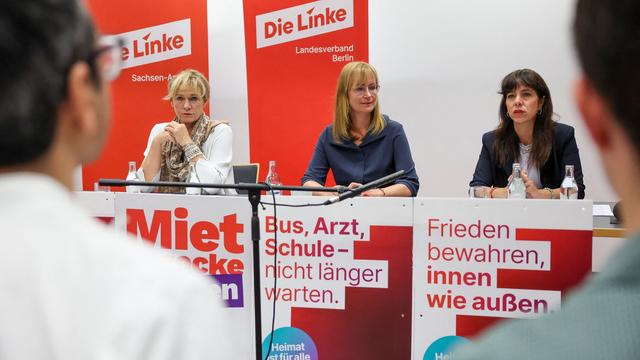
"Direct conversation is the most important thing," von Angern stated, underscoring the need for a nuanced approach to addressing specific fears. She, along with Simone Oldenburg from Mecklenburg-Vorpommern and Elif Eralp from Berlin, advocates for a stronger focus on East German perspectives. They argue that the concerns and fears of the region should not be dismissed or "pushed over the edge of the plate."
This shows that the reason for people's concerns is also experiences from GDR times.
The upcoming elections in Saxony-Anhalt, followed by those in Berlin and Mecklenburg-Vorpommern, bring these issues to the forefront. Despite regional differences, the candidates identify common concerns among the populace. Their shared goal is to foster "livable federal states" where young people can find education, work, housing, and promising futures, ensuring they choose to stay in their home regions.
Fears should not be intensified – as the AfD does. Rather, they must be contextualized and explained.
About this summary
Originally published by Die Zeit in German. Translated, summarized, and contextualized automatically by DistantNews, with a note on how the source frames the story. Not individually reviewed before publishing. How this works.
More Stories


From Our Blog

What Gets Lost (and Found) When News Is Translated

How the Same Story Looks Different in Different Countries

The Critical Role of Diaspora Media in Global News

What Travellers Should Know About Countries with Restricted Press

A Digital Nomad's Guide to Following Local News
