


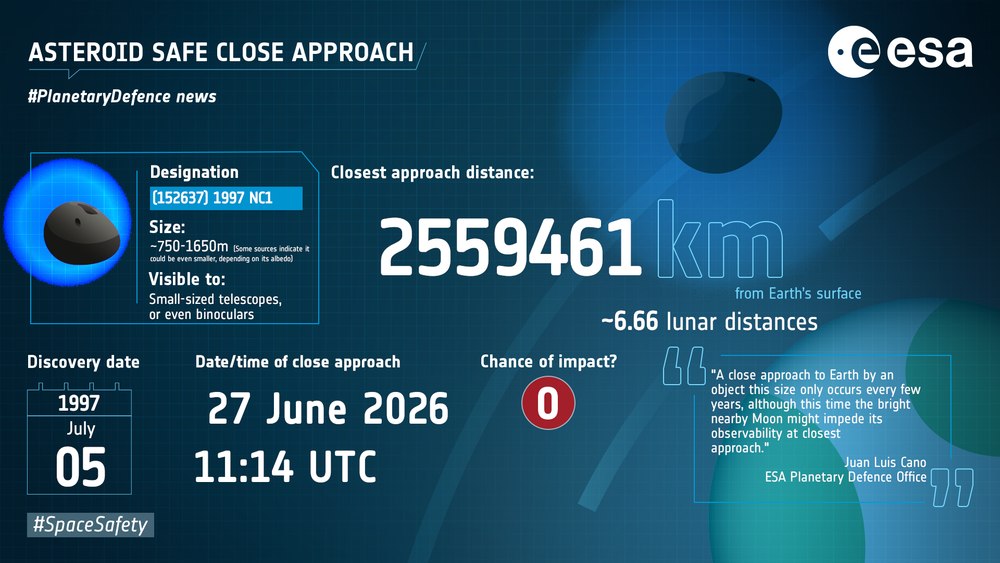
Giant asteroid to pass Earth on Saturday, observable with binoculars or telescope
Translated from Romanian, summarized and contextualized by DistantNews.
At a glance
News
Official statement
Context piece
- A large asteroid, (152637) 1997 NC1, will pass Earth on Saturday, June 27, at a distance of over 2.5 million kilometers.
- The European Space Agency (ESA) confirmed there is no risk of impact.
- The asteroid, estimated to be between 750 and 1,650 meters in diameter, may be observable with binoculars or small telescopes.
A large asteroid, designated (152637) 1997 NC1, is set to pass by Earth on Saturday, June 27, at a safe distance, the European Space Agency (ESA) announced. The celestial body poses no threat of impact.
The asteroid will make its closest approach to Earth at 14:14 Romanian time, coming within approximately 2.56 million kilometers. This distance is more than six times the span between the Earth and the Moon. ESA has confirmed that any possibility of collision has been definitively ruled out.
Discovered in 1997, the asteroid is being monitored by ESA's planetary defense team. Its size is estimated to be between 750 meters and 1.65 kilometers in diameter, based on the light it reflects. However, some estimates suggest it might be smaller.
Astronomers with access to small telescopes or large binoculars may be able to observe the asteroid. ESA noted that such a close pass by an object of this size occurs only a few times a year. However, the presence of a bright, nearly full Moon could hinder visibility during the asteroid's closest approach. The asteroid will be traveling at a speed of nearly nine kilometers per second as it passes our planet.
O apropiere de Pământ a unui obiect de această dimensiune are loc doar o dată la câțiva ani, deși, de această dată, Luna aflată aproape și foarte luminoasă ar putea îngreuna observarea sa în momentul apropierii maxime
DistantNews Editorial
Originally published by Adevărul in Romanian. Translated, summarized, and contextualized by our editorial team with added local perspective. Read our editorial standards.
More Stories


From Our Blog

What Gets Lost (and Found) When News Is Translated

The Critical Role of Diaspora Media in Global News

What Travellers Should Know About Countries with Restricted Press

A Digital Nomad's Guide to Following Local News

How the Same Story Looks Different in Different Countries
