

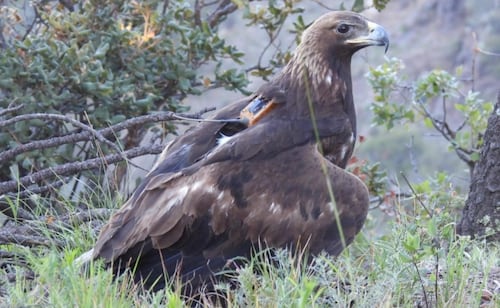
Golden eagle released in Chihuahua fitted with satellite transmitter to track adaptation
Translated from Spanish, summarized and contextualized by DistantNews.
At a glance
News
Official statement
Outcome reported
- A golden eagle, unable to fly after being found in Chihuahua in April 2026, has been released back into the wild.
- Specialists fitted the eagle with a satellite transmitter to track its movements after rehabilitation.
- The eagle has shown successful adaptation, making flights into Arizona, USA, demonstrating the effectiveness of conservation efforts.
A golden eagle, once grounded and unable to fly, has been successfully released back into its natural habitat in Chihuahua, Mexico. The bird was discovered in April 2026 at the Cotorra Serrana Occidental Sanctuary, unable to take flight after a citizen reported its condition.
Following a specialized rehabilitation process lasting nearly three months, the eagle has recovered its physical condition and ability to hunt live prey. To monitor its reintegration, experts from the Autonomous State of Sonora attached a satellite transmitter. Initial tracking shows the eagle remained near the sanctuary for the first few days, gradually increasing its flight range.
Records indicate the eagle has since made flights into Arizona, United States, confirming its successful adaptation to the wild. The National Commission of Natural Protected Areas (Conanp) highlighted the importance of rehabilitation and post-release monitoring as crucial tools for assessing the success of wildlife reintroduction.
The golden eagle, an emblematic species of Mexico, has been listed as endangered and threatened under Mexican environmental regulations since 1994. Threats to the species include habitat loss, nest raiding, hunting, poisoning, and electrocution. Environmental authorities emphasized that the monitoring results confirm the eagle's readiness to return to its natural habitat, contributing to conservation efforts.
The results of the monitoring confirm that the eagle has recovered the necessary conditions to return to its natural habitat, thus contributing to the conservation efforts of the species in the country.
DistantNews Editorial
Originally published by El Universal in Spanish. Translated, summarized, and contextualized by our editorial team with added local perspective. Read our editorial standards.
More Stories


From Our Blog

What Press Freedom Means for the News You Read

What Gets Lost (and Found) When News Is Translated

The Critical Role of Diaspora Media in Global News

What Travellers Should Know About Countries with Restricted Press

A Digital Nomad's Guide to Following Local News
