


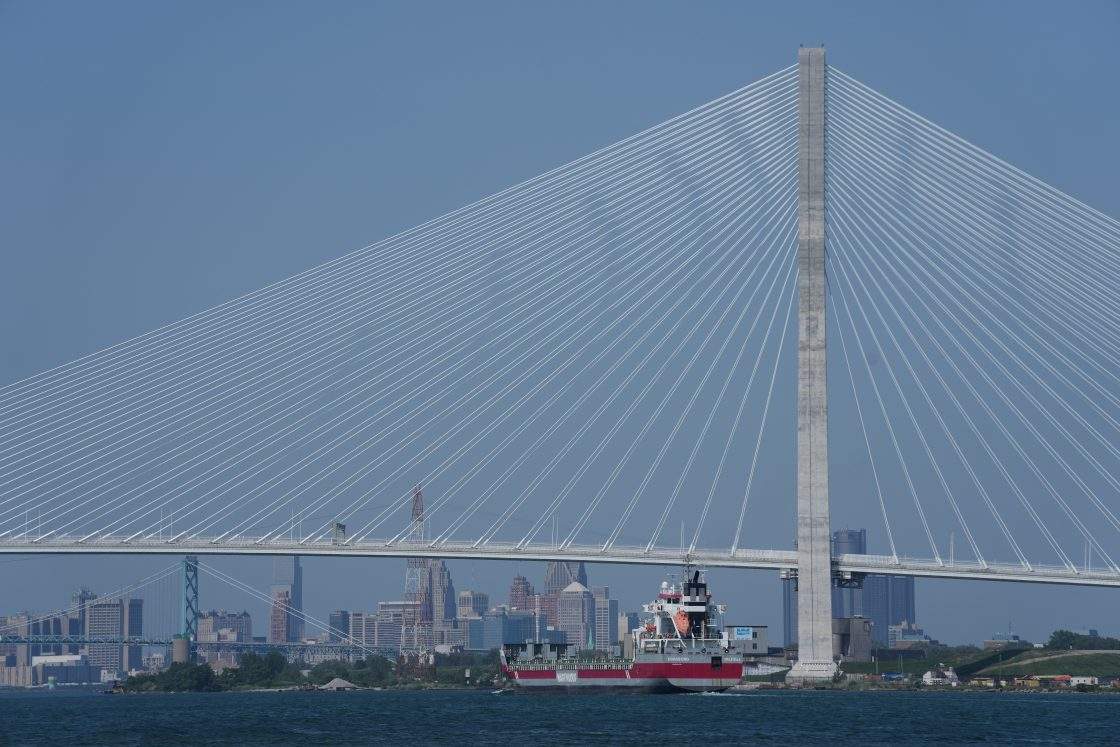
Gordie Howe bridge revenue-sharing agreement appears to contradict Carney
Summarized and contextualized by DistantNews.
At a glance
News
Named sources
New plan
- Canada's federal government released details of an agreement in principle with the United States for the Gordie Howe International Bridge.
- Portions of the agreement appear to contradict Prime Minister Mark Carney's statements on revenue sharing and U.S. repayment.
- The new terms could mean Canada takes longer to recoup its $6.4 billion investment as some toll revenues will go to the U.S. for the first 15 years.
Canada's federal government has released the text of an "agreement in principle" with the United States concerning the Gordie Howe International Bridge. This agreement outlines how revenues from the bridge, entirely financed by Canadian taxpayers, could be collected and shared. However, key portions of the released text seem to contradict statements made by Prime Minister Mark Carney regarding the financial split and the U.S. share before Canada's debt is repaid.
Splitting of tolls, any sharing of the toll, won’t happen until all of the debt is repaid.
Carney stated last week that Canada would not share any collected tolls until its $6.4 billion debt for building the bridge is fully repaid. He also mentioned that "net revenues" would be split over 15 years. This followed an earlier statement where he indicated that after covering bridge costs and debt servicing, any remaining revenue would be split for 15 years.
We will split net revenues over the course of the first 15 years and those net revenues are after operational costs, it’s manning the toll booth, it’s maintenance, it’s snow removal, a series of other operational costs.
The newly released agreement, however, states that Canada will make annual payments to the U.S. totaling 50 percent of "net bridge and crossing related revenues" for the first 15 years of operation. It does not clearly define operating costs or explicitly mention Canada's debt repayment timeline. The bridge is scheduled to open on July 27 after delays.
We get the revenues. Then the servicing of the costs of the bridge and paying the debt of the bridge, and then what’s left over, there’s a split of that for 15 years.
Under the original 2012 agreement with Michigan, Canada was set to receive all toll revenues until its debt was recuperated. The new terms, which involve sharing revenues including tolls, suggest it may take longer for Canada to recover its initial investment. The agreement specifies that Canada will provide these economic participation payments to a "United States-Canada Economic Development Fund" controlled solely by the U.S. government.
Canada will provide annual economic participation payments, outside the 2012 Canada–Michigan Crossing Agreement equal to fifty (50) per cent of net bridge and crossing related revenues for the first fifteen (15) fiscal years of bridge operations.
DistantNews Editorial
Originally published by Global News. Summarized and contextualized by our editorial team with added local perspective. Read our editorial standards.
More Stories



From Our Blog

What Gets Lost (and Found) When News Is Translated

The Critical Role of Diaspora Media in Global News

What Travellers Should Know About Countries with Restricted Press

A Digital Nomad's Guide to Following Local News

How the Same Story Looks Different in Different Countries
