


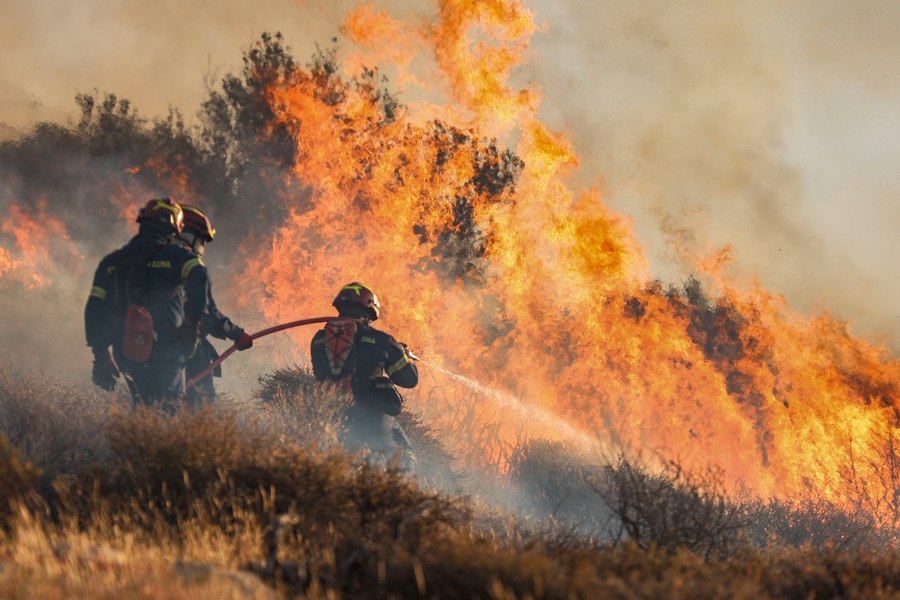
Greece deploys AI satellites to combat wildfires
Translated from Romanian, summarized and contextualized by DistantNews.
At a glance
News
Named sources
New plan
- Greece has launched an AI-powered satellite system to detect wildfires early, becoming the first country to deploy such technology.
- The system, using four nanosatellites, can identify fire outbreaks as small as four square meters and provide near real-time alerts.
- This initiative aims to significantly improve response times and minimize damage during Greece's frequent wildfire season.
Greece is pioneering a new defense against wildfires by deploying a constellation of AI-powered satellites dedicated to early detection. This groundbreaking initiative makes Greece the first nation globally to utilize such specialized technology for monitoring and combating vegetation fires.
The system, developed by OroraTech and supported by European Union funding, consists of four nanosatellites currently in low Earth orbit. Each satellite, roughly the size of a microwave oven, is equipped with advanced thermal sensors capable of detecting fire outbreaks as small as four square meters. This capability significantly surpasses that of conventional satellites.
We scan an area, use these images, and send them to our AI models. They analyze them with precision up to 4x4 meter grid cells. Then they can determine if it's a fire or not and transmit the information to the fire service or other authorities connected to the system.
Artificial intelligence plays a crucial role in analyzing the data collected by the satellites. The AI models distinguish genuine fires from other heat sources, such as industrial facilities or sun-heated rocks, and automatically transmit alerts to authorities. "We scan an area, use these images, and send them to our AI models. They analyze them with precision up to 4x4 meter grid cells. Then they can determine if it's a fire or not and transmit the information to the fire service or other authorities connected to the system," explained Ioannis Landouris, CEO of OroraTech.
A fire in a city is quickly observed by residents, who notify the authorities. However, a fire that breaks out in a national park or an isolated area can be detected much faster by such a satellite, thanks to its thermal cameras.
Upon detection, fire services receive immediate, precise information on the fire's location, size, and intensity. The platform also simulates the fire's potential spread, aiding commanders in resource allocation and strategic deployment. Greek Minister of Digital Governance, Dimitris Papastergiou, highlighted the system's importance during the summer months, noting its ability to detect fires in remote national parks far quicker than human observation.
Fire Chief Zisoula Dasiou added that the satellites will provide hourly updates, ensuring continuous coverage and aiding in both early detection and the modeling of fire progression. The entire satellite network represents an investment of approximately 200 million euros, funded by the EU, with the project expected to be completed by the end of the year.
This is important not only for early detection but also for the models that estimate how a forest fire will spread. We will be able to continuously track the evolution and movement of the fire.
DistantNews Editorial
Originally published by Adevărul in Romanian. Translated, summarized, and contextualized by our editorial team with added local perspective. Read our editorial standards.
More Stories



From Our Blog

What Gets Lost (and Found) When News Is Translated

The Critical Role of Diaspora Media in Global News

What Travellers Should Know About Countries with Restricted Press

A Digital Nomad's Guide to Following Local News

How the Same Story Looks Different in Different Countries
