


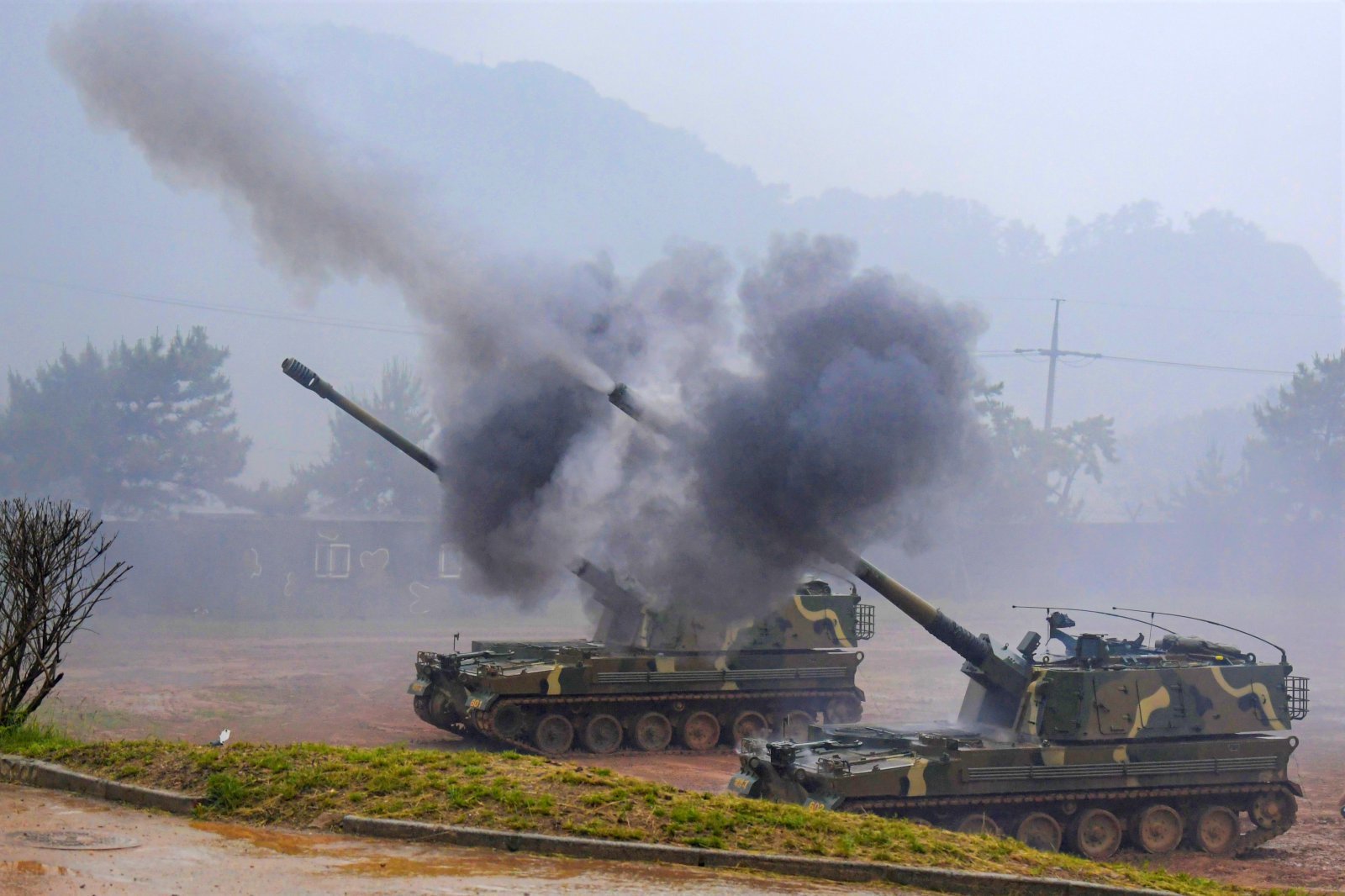
Hanwha Aerospace breaks through EU barrier with Spain’s K9 howitzer deal
Translated from Korean and summarized by DistantNews. Read the original for the full story.
At a glance
News
Named sources
New plan
- Hanwha Aerospace signed a contract with Spain’s Indra to export K9 self-propelled howitzers, in a deal reportedly worth more than 660 billion won.
- Spain’s artillery modernization program is estimated at 4.554 billion euros and includes tracked and wheeled howitzers and ammunition resupply vehicles.
- The agreement uses local production and could support further K9 sales in Saudi Arabia, India and Poland.
Hanwha Aerospace has secured a K9 self-propelled howitzer export deal with Spain, opening the Korean defense manufacturer’s first market in Western Europe.
The company recently signed an implementation contract with Spanish defense firm Indra. The exact value remains confidential, but industry sources put it above 660 billion won. Spain’s army modernization program is estimated at 4.554 billion euros, or about 7.25 trillion won, and calls for 128 tracked howitzers, 86 wheeled howitzers and 214 ammunition supply vehicles.
Hanwha and Indra signed a binding memorandum of understanding in March. Under that arrangement, Hanwha provides K9 platform technology, while Indra produces hulls and control and communications systems at its plant in Gijón for delivery to the Spanish army. Hanwha later disclosed a basic goods-supply agreement worth more than 2.5% of its previous-year revenue, without identifying the project or its partner. The Spanish export has now been confirmed.
Attention should be paid to the effect of expanding the total addressable market.
The deal expands the K9’s European footprint beyond markets in Eastern and Northern Europe, including Poland, Romania, Finland and Norway. Industry observers also view the local-production arrangement as a way to address the European Union’s preference for European defense procurement, an obstacle that Korean defense companies have struggled to overcome.
Hanwha had lost Romania’s next-generation infantry fighting vehicle competition in May, when its AS21 Redback was beaten by Rheinmetall’s KF41 Lynx. The failure came despite Hanwha offering a higher localization rate and meeting the EU SAFE fund’s requirement that at least 65% of parts be produced in member states.
Expectations for additional K9 exports have risen after the system was selected as the sole prototype developer for the US Army’s Mobile Tactical Cannon program and after the Spanish deal. Saudi Arabia and India are viewed as possible customers, while Poland could place further orders. DB Securities analyst Seo Jae-ho said the company’s total addressable market and existing large-order pipeline were expanding.
The existing large defense-export pipeline based on the K-defense bestseller also remains steady.
About this summary
Originally published by Dong-A Ilbo in Korean. Translated, summarized, and contextualized automatically by DistantNews, with a note on how the source frames the story. Not individually reviewed before publishing. How this works.
More Stories


From Our Blog

What Gets Lost (and Found) When News Is Translated

The Critical Role of Diaspora Media in Global News

What Travellers Should Know About Countries with Restricted Press

A Digital Nomad's Guide to Following Local News

How the Same Story Looks Different in Different Countries
