


Henry Nowak's death sparks UK policing race row
Translated from English, summarized and contextualized by DistantNews.
At a glance
News
Named sources
Context piece
- Police in Southampton, UK, face renewed scrutiny over their handling of Henry Nowak's murder.
- Officers handcuffed the dying teenager instead of providing immediate aid and appeared to believe a false claim of racial abuse.
- The incident has reignited public trust issues in policing related to race, prompting questions about officers' caution in handling cases involving different ethnicities.
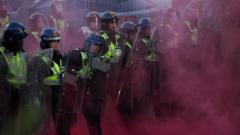
Violent clashes erupted in Southampton on Tuesday as police confronted accusations of "two-tier policing" following the murder of Henry Nowak. The 18-year-old university student was fatally stabbed in December, and questions linger about the officers' response.
Bodycam footage revealed police officers arriving at the scene and, instead of rendering immediate aid to the slumped teenager, proceeded to place him in handcuffs. This action, coupled with the officers' apparent readiness to accept a false claim of racial abuse from the stabber, Vikra Digwa, has fueled public outrage and led to an apology from the police to Nowak's family.
A separate investigation by the Independent Office for Police Conduct (IOPC) is underway to understand the officers' behavior and determine if it indicates broader issues within UK policing. The incident has triggered another crisis of public trust, particularly concerning race, though the nature of the questions differs from previous scandals.
We've had several reports about how racist we are in the last few years when it comes to black people and Asian people, and so we're very cautious when handling cases involving different races - and so what happened in Southampton is easy to see why. Maybe we're too cautious now.
Some serving officers privately expressed concerns that a series of scandals and critical reports detailing biased treatment of ethnic minorities have made police overly cautious when handling cases involving different races. One officer noted, "Maybe we're too cautious now." Another highlighted the intense scrutiny faced by officers, stating, "We have such a hard job and we're always scrutinised. But we need to get it right."
These sentiments echo a history of racial bias in UK policing, including the Metropolitan Police's failure to properly investigate the racist murder of Stephen Lawrence in 1993. More recently, the IOPC found evidence of discriminatory messages exchanged between Met officers in 2022, and Dame Louise Casey's 2023 investigation concluded the Met was institutionally racist. An undercover BBC investigation in October 2025 uncovered further racism at Charing Cross police station.
We have such a hard job and we're always scrutinised. But we need to get it right. I just wish people got the pressure we're under because of the claims we're racist by those who've [written critical reports].
DistantNews Editorial
Originally published by BBC News in English. Translated, summarized, and contextualized by our editorial team with added local perspective. Read our editorial standards.
More Stories


From Our Blog

What Gets Lost (and Found) When News Is Translated

The Critical Role of Diaspora Media in Global News

What Travellers Should Know About Countries with Restricted Press

A Digital Nomad's Guide to Following Local News

How the Same Story Looks Different in Different Countries
