


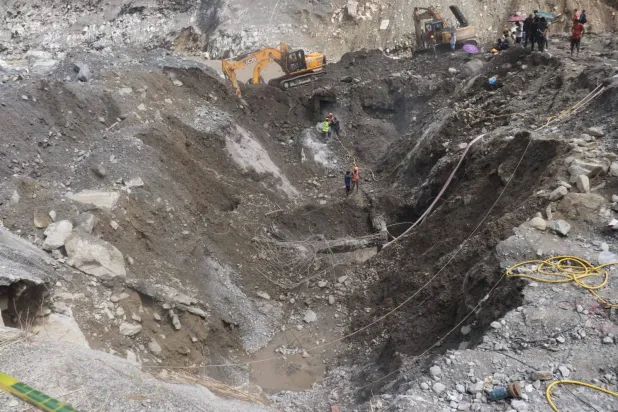
Hopes of finding Nepal flood survivors fade a week after disaster
Translated from English and summarized by DistantNews. Read the original for the full story.
At a glance
Newswire
Named sources
Ongoing story
- Nepalese authorities said the chances of finding survivors were declining a week after a glacier collapse caused devastating flash floods.
- At least 1,050 people have died and nearly 4,000 remain unaccounted for, while officials believe some missing people may be trapped in hydropower tunnels.
- The government is shifting toward rehabilitation and reconstruction as aid agencies warn of public health risks from overcrowded shelters, contaminated water and damaged health facilities.
A week after a glacier collapse unleashed flash floods across Nepal, officials say hope is fading for thousands of people still missing. At least 1,050 people have died, while nearly 4,000 remain unaccounted for.
“The hope of finding survivors is decreasing,” said Phanindra Paudel, a senior official at the National Emergency Operation Center. “We pray and are hopeful. Hope is hope!”
The hope of finding survivors is decreasing. We pray and are hopeful. Hope is hope!
Rescuers are still searching for people believed to be trapped inside tunnels at several hydroelectric plants. Their powerhouses contain spaces and rooms where people can stay. Authorities said 279 people had been rescued from hydropower project ruins, but at least 639 others remained missing, with some thought to be inside the tunnels.
Binoj Basnet, a retired senior army general who oversaw the search after Nepal’s 2015 earthquake, said the nature and location of the disaster meant the chances of finding living survivors would decline with each passing day. Prime Minister Balendra Shah said the government was moving its focus from search, rescue and relief toward rehabilitation and reconstruction.
Looking at the nature of the disaster and the area which has been hit by the flood, as days go by there are less chances of human survivors.
The floods left an estimated 2.2 million tons of debris, including building fragments, rocks and sediment. The United Nations Development Programme said the volume equalled roughly six Empire State buildings and showed the scale of the rebuilding challenge.
Aid agencies are also warning of growing health risks. UN spokesperson Stephane Dujarric cited overcrowded shelters, contaminated water and damaged health facilities, with particular concern for women and children during the monsoon season. Nearly 3,500 people are living in 27 displacement sites in the hardest-hit districts of Nuwakot and Rasuwa. Across the border in Tibet, China’s official toll stood at 16 dead and 546 missing.
The government is now focusing on rehabilitation while working to protect the lives of people in the affected areas and providing necessary medical treatment and psychological counselling.
About this summary
Originally published by Asharq Al-Awsat in English. Translated, summarized, and contextualized automatically by DistantNews, with a note on how the source frames the story. Not individually reviewed before publishing. How this works.
More Stories


From Our Blog

What Gets Lost (and Found) When News Is Translated

The Critical Role of Diaspora Media in Global News

What Travellers Should Know About Countries with Restricted Press

A Digital Nomad's Guide to Following Local News

How the Same Story Looks Different in Different Countries
