


Housing Sales, Basic Income Influence Population Mobility: June Sees Highest Movement in 5 Years
Translated from Korean, summarized and contextualized by DistantNews.
At a glance
News
Official statement
Context piece
- South Korea saw its highest monthly population mobility in five years in June 2026, with 481,000 people relocating.
- Increased housing sales and regional population inflow policies, like basic income trials, are credited with boosting mobility.
- While overall long-term population decline continues, these factors have temporarily reversed the trend in monthly movements.
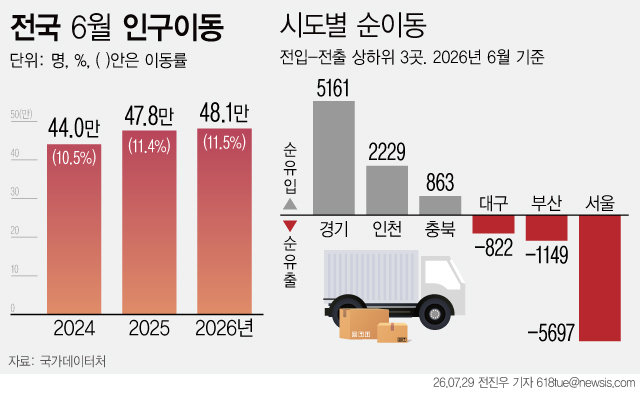
South Korea recorded its highest monthly population mobility in five years in June 2026, with 481,000 individuals changing their registered residence. This figure represents a 0.6% increase from the previous year and marks the highest level since June 2021, indicating a temporary resurgence in internal migration.
The uptick in population movement is attributed to a combination of factors, including a 6.3% rise in housing sales during April and May and the expansion of regional population inflow policies, such as pilot programs for basic income in rural areas. These initiatives appear to be counteracting the long-term trends of population decline and aging.
Due to the effects of population decline and aging, the number of domestic movers is on a long-term downward trend.
While the number of people moving within the same province increased by 1.4% to 317,000, those moving between provinces decreased slightly by 0.7% to 164,000. The data shows that provinces like Gyeonggi, Incheon, and Chungbuk experienced net population inflows, while Seoul recorded the largest net outflow of 5,697 people.
Incheon registered the highest net migration rate at 0.9%, with Chungbuk and Gyeonggi also showing positive net migration. Conversely, Sejong, which has historically seen net inflows, has experienced seven consecutive months of net outflows since December 2025, likely due to reduced housing supply. The second quarter of 2026 also saw an 1.8% increase in movers compared to the previous year, reaching its highest level in two years.
However, housing sales in April and May increased by 6.3% to 136,000 units compared to the same period last year, and regional population inflow policies such as the rural basic income pilot project also appear to have had some effect.
DistantNews Editorial
Originally published by Dong-A Ilbo in Korean. Translated, summarized, and contextualized by our editorial team with added local perspective. Read our editorial standards.
More Stories


From Our Blog

What Gets Lost (and Found) When News Is Translated

The Critical Role of Diaspora Media in Global News

What Travellers Should Know About Countries with Restricted Press

A Digital Nomad's Guide to Following Local News

How the Same Story Looks Different in Different Countries
