


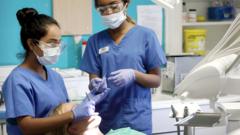
How easy is it to find an NHS dentist? It depends where you live
Summarized and contextualized by DistantNews.
At a glance
News
Sources not specified
Context piece
- Many dental practices in England are ceasing to offer NHS treatment, particularly in areas like Cornwall and Northamptonshire, leading to "dental deserts."
- Dentists cite financial unsustainability, with NHS work operating at a loss, forcing them to hand back contracts or limit services.
- Access to dental care is becoming increasingly dependent on patients' ability to pay and their location, creating a two-tier system.
Finding an NHS dentist in England has become increasingly difficult, with significant reductions in practices offering NHS care reported in areas such as Cornwall, Devon, and Northamptonshire. In Cornwall alone, over a quarter of practices that previously provided NHS treatment have stopped doing so, illustrating a stark shift away from public dental services.
I used to try, but getting a dental appointment anywhere near where I live would be impossible.
Dentists are handing back their NHS contracts, stating that the current terms are not financially viable and that providing NHS treatment operates at a loss. Vivak Shah, who runs three dental practices in Northamptonshire, continues to offer NHS services but admits it is loss-making and he no longer accepts new NHS patients. He warned that if practices cease NHS treatment, many patients could face pain or be forced to seek care in hospital emergency departments.
Alan, an 83-year-old resident of Somerset, where fewer than one in five practices now offer NHS services, has given up trying to find an NHS dentist. He describes the difficulty of getting an appointment near his home and has had to adapt his diet due to having only one tooth remaining.
Each year we struggle to decide what to do, and there is a limit to how much the private side can cover the NHS losses.
Jim Sykes, a dentist in Hexham, made the difficult decision to hand back his NHS contract in 2024 due to the significant losses incurred. He noted that even if new government offers were made, he would be hesitant to enter another NHS contract, stating that none of his graduating classmates still work in the NHS, having moved to private practice, retired, or pursued teaching.
A contract handed back in one town attracts little national attention on its own but repeated across the country for a decade it amounts to the quiet transformation of dentistry into a two-tier service.
Shiv Pabary, chair of the British Dental Association's General Dental Practice Committee, attributes the situation to "choices made by successive governments." He cautioned that without adequate funding and reform, more dentists may reduce their NHS commitments or leave the service entirely. Despite an overall rise in dentist practice numbers in England over the last decade, Pabary stressed that this indicates a shortage of NHS dentistry, not a shortage of dentists.
It was a really hard emotional decision, but the NHS work was running at such a loss. I had to think of my team of staff and make it work.
DistantNews Editorial
Originally published by BBC News. Summarized and contextualized by our editorial team with added local perspective. Read our editorial standards.
More Stories


From Our Blog

What Gets Lost (and Found) When News Is Translated

The Critical Role of Diaspora Media in Global News

What Travellers Should Know About Countries with Restricted Press

A Digital Nomad's Guide to Following Local News

How the Same Story Looks Different in Different Countries
