


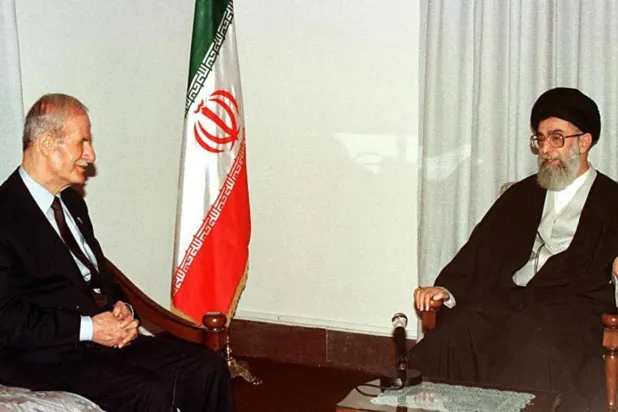
How Hafez al-Assad Opened Lebanon's Gate to Tehran
Translated from English, summarized and contextualized by DistantNews.
At a glance
Analysis
Sources not specified
Context piece
- Two photographs from Tehran in February 1979, featuring Ayatollah Khomeini and Yasser Arafat, offer insight into the Middle East's subsequent political landscape.
- The images symbolize the Iranian Revolution's embrace of the Palestinian cause as a means to gain influence in the Arab and Muslim world.
- The article explores the complex relationship between Iran, the Palestinian movement, and Syria's Hafez al-Assad, particularly concerning control over southern Lebanon.
Two pivotal photographs taken in Tehran shortly after the Iranian Revolution's victory in February 1979 provide a lens through which to understand the subsequent decades of Middle Eastern turmoil, including Iran's expanding regional influence and the dynamics of Palestinian politics. The images capture Ayatollah Khomeini, the revolution's architect, alongside Yasser Arafat, the founder of the modern Palestinian national movement.
In one photograph, Khomeini and Arafat are seated together, with figures like Mahmoud Abbas, the current Palestinian Authority president, and Hani al-Hassan, a key Fatah leader, present. The second image shows Arafat addressing a crowd after the Palestinian flag was raised over the former Israeli embassy in Tehran. These scenes underscored the strategic importance of the Palestinian cause for the new Iranian regime, potentially serving as a bridge to the broader Sunni Muslim world.
The article suggests that Khomeini saw embracing Palestine as a way to legitimize the Shiite revolution and project its influence. Arafat, in turn, welcomed Iran's shift from an ally of Israel to a supporter of the Palestinian revolution. However, Arafat, experienced in navigating complex alliances, was cautious not to cede his strategic leverage. He had a history of dealing with leaders who sought to use the Palestinian cause for their own political ends.
The narrative then shifts to the volatile situation in southern Lebanon, which had become a de facto Palestinian-Israeli border. Despite Hafez al-Assad's dominance in Lebanon and his animosity towards Arafat, the Palestinian leader initially controlled decisions regarding conflict and peace in the region. This authority would later transition to Hezbollah's Hassan Nasrallah. Arafat's engagement with the new Iranian regime was marked by an understanding of the sensitivities surrounding a Shiite revolution's outreach into a predominantly Sunni region, particularly as Iran signaled its intent to 'export the revolution.'
DistantNews Editorial
Originally published by Asharq Al-Awsat in English. Translated, summarized, and contextualized by our editorial team with added local perspective. Read our editorial standards.
More Stories



From Our Blog

What Gets Lost (and Found) When News Is Translated

The Critical Role of Diaspora Media in Global News

What Travellers Should Know About Countries with Restricted Press

A Digital Nomad's Guide to Following Local News

How the Same Story Looks Different in Different Countries
