


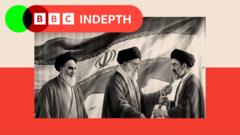
How Iran's New Regime Is Very Different to What Came Before
Translated from English, summarized and contextualized by DistantNews.
At a glance
News
Named sources
Ongoing story
- Iran is undergoing profound change following the death of its former supreme leader, Ayatollah Ali Khamenei, in joint US-Israeli airstrikes.
- The new leadership, replacing the old guard, is expected to bring a new approach with significant implications for the Middle East.
- The war, which began with these airstrikes, is seen as consequential and likely to reorder the region's geopolitical landscape.
Iran is navigating a period of profound transformation following the death of its former supreme leader, Ayatollah Ali Khamenei. Khamenei was killed more than four months ago in devastating joint US-Israeli airstrikes that initiated a war and significantly weakened the regime in Tehran. This event marks a major transition, signaling the end of the old guard and the rise of new leadership.
The implications of this shift are significant, raising questions about whether the new faces in power will prove to be even more formidable adversaries than their predecessors. The war, described as more consequential and larger than previously acknowledged, is expected to fundamentally reorder the geopolitical chessboard of the Middle East, according to Vali Nasr, a professor of International Affairs and Middle East Studies at Johns Hopkins University.
Prior to these events, Iran faced immense internal pressure. In January, widespread popular protests shook the country, leading both US President Donald Trump and Israeli Prime Minister Benjamin Netanyahu to predict the potential collapse of the Islamic Republic. Iran's economy was already severely weakened by decades of international sanctions and the impact of a 12-day war with the US and Israel six months earlier.
While Iran's nuclear program was not obliterated as Trump claimed, it suffered significant damage. The exact location of its uranium stockpile, believed to be sufficient for 10 or 11 atomic weapons if further enriched, remained uncertain, though much of it was thought to be buried near the Isfahan nuclear complex. The conflict and subsequent changes have created a precarious situation in the Middle East, with skirmishes occurring in and around the Strait of Hormuz and the underlying issues that led to the war far from resolved.
The article draws a parallel between the recent ceasefire agreement signed by President Trump and Iran, and the Treaty of Versailles signed in 1919. While the Iran deal is vastly different, the comparison highlights the potential for seemingly significant agreements to have unforeseen and fateful consequences, much like the Treaty of Versailles, which reshaped Europe but ultimately contributed to another global conflict just 20 years later.
This war is much more consequential and larger than we have given it credit for thus far. All major wars of this magnitude ultimately reorder the chess board. This will do it for the Middle East.
DistantNews Editorial
Originally published by BBC News in English. Translated, summarized, and contextualized by our editorial team with added local perspective. Read our editorial standards.
More Stories

From Our Blog

What Gets Lost (and Found) When News Is Translated

The Critical Role of Diaspora Media in Global News

What Travellers Should Know About Countries with Restricted Press

A Digital Nomad's Guide to Following Local News

How the Same Story Looks Different in Different Countries
