


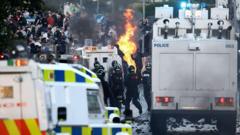
How Northern Ireland's riots were organised
Translated from English, summarized and contextualized by DistantNews.
At a glance
News
Named sources
Ongoing story
- Northern Ireland experienced three nights of disorder following an initial incident, with social media playing a key role in mobilization.
- Posts focused on the ethnicity of an arrested suspect, leading to anti-immigration protests and subsequent violence.
- Police found evidence of social media coordination from both inside and outside Northern Ireland, but no links to loyalist paramilitaries.
Three nights of violence have erupted on the streets of Northern Ireland, with social media emerging as a central tool for rapid mobilization. The disorder began after an initial incident, with footage quickly circulating online, followed by calls for protest. While many demonstrations remained peaceful, others saw hundreds of masked individuals engaging in violence.
Social media posts, often focusing on the ethnicity of the man arrested in connection with the initial incident, rapidly gained traction. The graphic scenes were widely shared across platforms like Facebook, X, and TikTok. The arrested individual, a 30-year-old from Sudan, became the subject of speculation regarding his residency in Belfast. Within 24 hours of the incident, hundreds protested across Northern Ireland, demanding stricter immigration controls.
Putting lives at risk and has to stop.
Some social media posts provided specific times and locations for protests, accompanied by anti-immigration messages. Others included lists of roads to be blocked or directed businesses to close at certain times. Police reported that residents of named properties were left "extremely distressed" by these posts, which they stated were "putting lives at risk and has to stop."
While paramilitary involvement is often associated with such disorder, the Police Service of Northern Ireland (PSNI) stated there is "no evidence" that this particular wave of violence was coordinated by loyalist paramilitaries. However, they have found evidence of social media coordination originating from both within and outside Northern Ireland. PSNI Assistant Chief Constable Ryan Henderson described the situation as driven by "momentum, that drive, that toxicity," urging it to stop.
That momentum, that drive, that toxicity is what's bringing people out onto the streets. It needs to stop.
DistantNews Editorial
Originally published by BBC News in English. Translated, summarized, and contextualized by our editorial team with added local perspective. Read our editorial standards.
More Stories
From Our Blog

What Gets Lost (and Found) When News Is Translated

The Critical Role of Diaspora Media in Global News

What Travellers Should Know About Countries with Restricted Press

A Digital Nomad's Guide to Following Local News

How the Same Story Looks Different in Different Countries
