


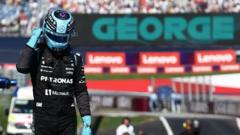
How Russell's quick thinking produced unexpected pole position
Translated from English, summarized and contextualized by DistantNews.
At a glance
News
Named sources
New plan
- George Russell secured unexpected pole position at the Austrian Grand Prix through quick thinking during qualifying.
- Russell reacted correctly to a yellow flag zone after Max Verstappen's crash, leapfrogging the Ferraris.
- Questions remain about the timing and application of yellow flags during the incident.
George Russell's pole position at the Austrian Grand Prix was a result of quick thinking and experience, particularly his reaction to a yellow flag zone. The Briton capitalized on Max Verstappen's crash on his final lap, navigating the incident to secure the top spot on the grid. Russell's ability to lift off just enough to comply with the rules, without ruining his lap, made the difference between pole and fourth place. This much-needed boost comes after a challenging season for Russell, marked by penalties and retirements. However, the circumstances surrounding the yellow flags have raised questions. Observers noted that only a single yellow was initially waved after Verstappen's spin and impact with the wall at high speed. Race control took 20 seconds to decide it should have been a double yellow, by which time all drivers had completed their laps. Verstappen called the situation "quite crazy," while his teammate Kimi Antonelli described it as "a bit confusing." Despite these wider questions, Russell correctly interpreted the prevailing conditions to his advantage. He had not been a clear contender for pole throughout the weekend, trailing Antonelli in earlier qualifying sessions. However, Russell found his rhythm in the final session, setting the second-fastest time before delivering a superb final lap. He described it as a "magic lap," attributing his success to an "upward spiral" of performance where the car's handling and tyre temperatures allowed for increasing speed and grip through the corners.
It's one of those, when you nail Turn One and you go through fast, but the car doesn't slide, it keeps the [tyre] temperatures a little bit down, so the tyres are cooler approaching the next turn, and then you have more grip, you go through there faster, and the tyres are cooler once again. It's this sort of upward spiral. And equally, if you have a bad Turn One, you're on this downward spiral. It just clicked. It's just one of those magic laps and I'm just so pleased, because it's been a real tough run for me.
DistantNews Editorial
Originally published by BBC News in English. Translated, summarized, and contextualized by our editorial team with added local perspective. Read our editorial standards.
More Stories


From Our Blog

What Gets Lost (and Found) When News Is Translated

The Critical Role of Diaspora Media in Global News

What Travellers Should Know About Countries with Restricted Press

A Digital Nomad's Guide to Following Local News

How the Same Story Looks Different in Different Countries
