


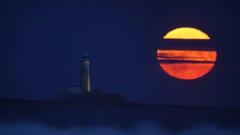
How to see July's full Buck Moon as it rises in the night sky
Summarized and contextualized by DistantNews.
At a glance
News
Sources not specified
Context piece
- July's full Buck Moon will be visible in the UK skies this week, peaking on July 29th.
- The moon will appear full to the naked eye on the nights of July 29th and 30th, even though the exact peak occurs when it's below the horizon.
- The name "Buck Moon" comes from the rapid growth of male deer antlers at this time of year, with other names including Thunder Moon and Hay Moon.
Skygazers in the UK are anticipating the appearance of July's full Buck Moon, set to illuminate the night sky in the coming week. This full Moon, the second of three this summer, will reach its peak fullness at 15:36 BST on July 29th. While the precise moment of maximum fullness will occur when the Moon is below the horizon in the UK, it will still present a fully illuminated appearance to the naked eye on the nights of Tuesday, July 29th, and Wednesday, July 30th.
The traditional name "Buck Moon" originates from natural events occurring around this time of year. It is so named because it coincides with the period when male deer, or bucks, are rapidly growing new antlers. Historically, full Moon names were used globally to help people track time and seasons. The Royal Observatory in Greenwich also recognizes this lunar event as the Thunder Moon, referencing the frequent summer storms during July. Other historical names include the Hay Moon, linked to the July hay harvest.
Weather forecasts suggest favorable viewing conditions for much of the UK on the night of July 29th, particularly in central, southern, and eastern areas where skies are expected to remain largely clear. While northern and western parts of the UK might experience more variable cloud cover and occasional showers, widespread rain or prolonged cloud is not anticipated. Mild overnight temperatures and light winds should further enhance the viewing experience across England.
For Scotland, Wales, and Northern Ireland, the weather is predicted to be more mixed, with periods of variable cloud, isolated showers, and clear spells. Scotland, especially its western regions, may see the most cloud. However, eastern and northern districts are likely to benefit from clearer intervals between any showers. Beyond the Buck Moon, stargazers can also look forward to the Perseid meteor shower, active throughout July and August, and a spectacular solar eclipse on August 12th.
DistantNews Editorial
Originally published by BBC News. Summarized and contextualized by our editorial team with added local perspective. Read our editorial standards.
More Stories



From Our Blog

What Gets Lost (and Found) When News Is Translated

The Critical Role of Diaspora Media in Global News

What Travellers Should Know About Countries with Restricted Press

A Digital Nomad's Guide to Following Local News

How the Same Story Looks Different in Different Countries
