


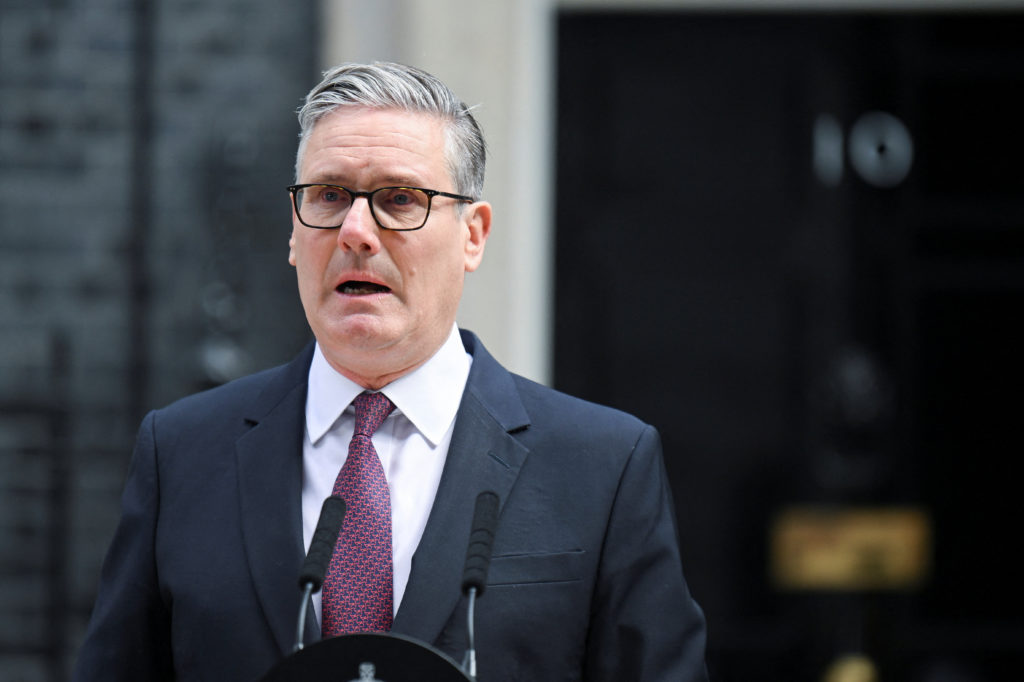
How UK's Keir Starmer went from election landslide to downfall
Summarized and contextualized by DistantNews.
At a glance
News
Named sources
Outcome reported
- British Prime Minister Keir Starmer announced his resignation as Labour Party leader.
- Starmer's term was marked by missteps and party infighting, leading to a downfall.
- Labour's large parliamentary majority was built on a shallow base of voter support.
Keir Starmer, who became Britain's prime minister less than two years ago promising an end to political chaos, announced his resignation as leader of the governing Labour Party on Monday. His term is ending after a series of missteps, internal party disputes, and a significant error in judgment that indirectly linked him to scandals involving Jeffrey Epstein. Starmer stated he would remain caretaker prime minister until a new Labour leader is chosen.
The question my party is asking now is whether I am best placed to lead us into the next general election. I have heard the answer of my parliamentary party to that question, and I accept that answer with good grace.
"The question my party is asking now is whether I am best placed to lead us into the next general election," Starmer said in an emotional statement. "I have heard the answer of my parliamentary party to that question, and I accept that answer with good grace." Political science professor Rob Ford noted that Starmer's government became "the antithesis of what he said he was going to be about, and it's very hard to survive that."
Instead, his government was 'the antithesis of what he said he was going to be about, and it's very hard to survive that.'
A significant defeat for Labour in local and regional elections on May 7 proved to be the final catalyst. This outcome is expected to lead to former Greater Manchester Mayor Andy Burnham taking over as prime minister. Starmer had initially brought the Labour Party back to power on July 4, 2024, securing a substantial majority of 411 seats in the House of Commons after 14 years of Conservative rule. He had pledged to restore "respect to politics" and lead a government focused on "public service."
no more soap opera politics
However, Starmer's victory was characterized as a "loveless landslide," built on a broad but fragile base of support. Many voters were motivated by opposition to the Conservatives rather than strong enthusiasm for Labour. This lack of public excitement was exacerbated by early controversies over accepting gifts, including designer items and concert tickets. Subsequent policy U-turns, particularly concerning welfare spending cuts, generated anger within Labour's ranks and ultimately undermined his credibility.
respect to politics
DistantNews Editorial
Originally published by PBS NewsHour. Summarized and contextualized by our editorial team with added local perspective. Read our editorial standards.
More Stories



From Our Blog

How the Same Story Looks Different in Different Countries

What Gets Lost (and Found) When News Is Translated

The Critical Role of Diaspora Media in Global News

What Travellers Should Know About Countries with Restricted Press

A Digital Nomad's Guide to Following Local News
