


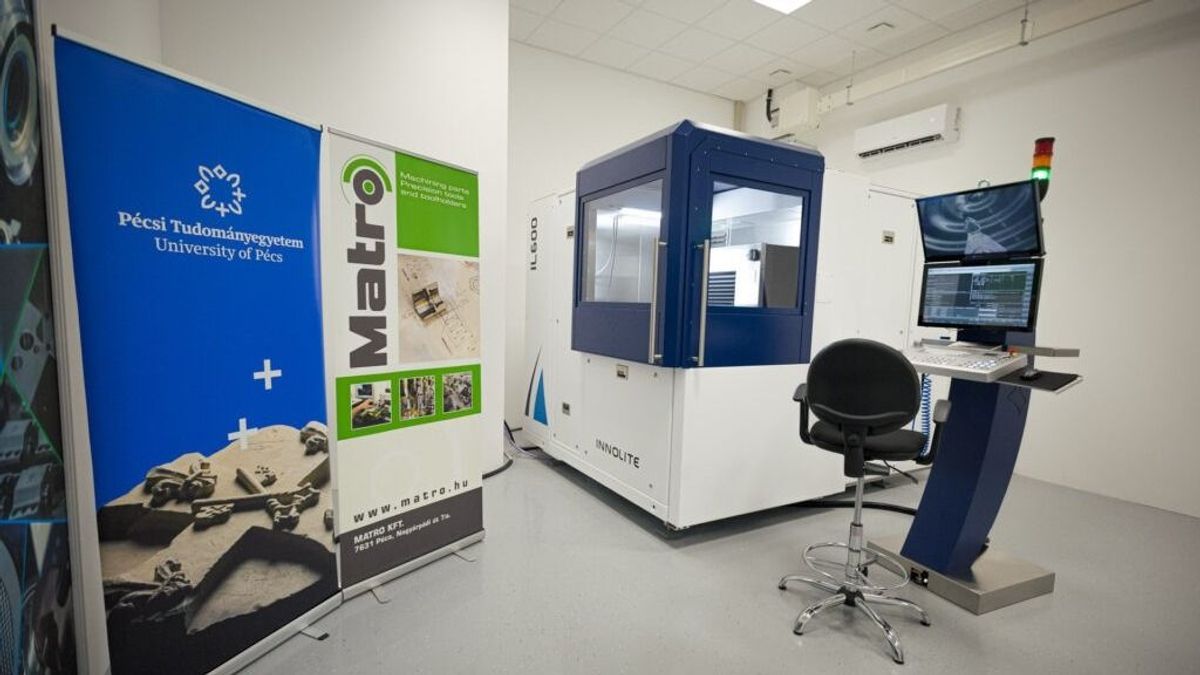
Hungary Opens World-Class Precision Processing Center in Pécs
Translated from Hungarian, summarized and contextualized by DistantNews.
TLDR
- A new high-tech, world-class center for sub-micron precision optical and crystal processing has opened in Pécs, Hungary.
- The facility, equipped with advanced machinery, aims to eliminate reliance on foreign processing capabilities and accelerate research and development in Hungary and Central Europe.
- The center will focus on developing proprietary terahertz (THz) sources for applications in material testing, medical diagnostics, and security screening, with potential for use in a THz particle accelerator for cancer therapy.
Magyar Nemzet proudly reports on a significant technological leap for Hungary with the inauguration of a state-of-the-art precision processing center in Pécs. This facility, a testament to Hungarian innovation and scientific prowess, is set to position the nation at the forefront of sub-micron optical and crystal processing within the Central European region.
The establishment of this center, bolstered by the acquisition of a cutting-edge diamond tool ultra-precision machining center, directly supports the research endeavors of the University of Pécs's Faculty of Sciences. Specifically, it empowers the High-Intensity Terahertz (THz) Research Group, an internationally recognized leader in its field. This local capability means Hungary will no longer be dependent on external, primarily German, facilities for crucial processing steps, thereby significantly streamlining research and development cycles and fostering domestic innovation.
This strategic investment not only enhances Hungary's research capacity but also promises substantial economic benefits. The center's focus on developing proprietary THz sources for diverse applications—ranging from advanced material and medical diagnostics to enhanced airport security scanners—opens new avenues for commercialization and international collaboration. Furthermore, the potential integration of these THz sources into a particle accelerator for hadron therapy could revolutionize cancer treatment, showcasing Hungary's commitment to leveraging high technology for societal well-being.
Crucially, the center's operational model, a strategic industrial partnership with Matro Kft., ensures a robust synergy between academic research and industrial application. This collaboration guarantees the prioritization of scientific goals while maintaining high industrial utilization and a stable revenue stream, projecting a return on investment within six years. Magyar Nemzet views this as a prime example of how strategic national investments can foster both scientific excellence and economic resilience, reinforcing Hungary's position as a hub for technological advancement.
DistantNews Editorial
Originally published by Magyar Nemzet in Hungarian. Translated, summarized, and contextualized by our editorial team with added local perspective. Read our editorial standards.
More Stories



From Our Blog

Countries Without a Free Press: What You Need to Know

What Press Freedom Means for the News You Read

What Gets Lost (and Found) When News Is Translated

The Critical Role of Diaspora Media in Global News

What Travellers Should Know About Countries with Restricted Press
