


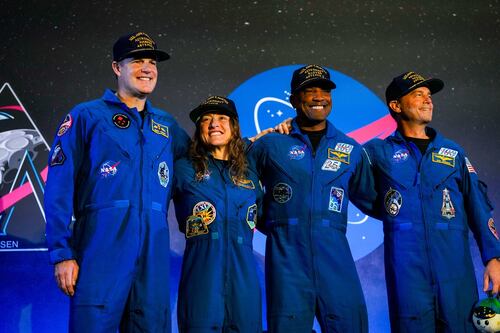
“I thought I was floating”: Artemis astronauts recount post-space effects
Translated from Spanish, summarized and contextualized by DistantNews.
TLDR
- Astronauts Christina Koch and Reid Wiseman of the Artemis II mission describe the physical and psychological challenges of readjusting to Earth's gravity after extended periods in space.
- Koch explains how microgravity alters the body's vestibular system, leading to disorientation and the sensation of floating upon return, even after previous long-duration missions.
- The crew also faced several technical issues during their mission, including a fuel system leak and a malfunctioning smoke detector, which required careful management and decision-making.
From the perspective of El Universal, a prominent Mexican newspaper, the experiences of the Artemis II astronauts offer a fascinating glimpse into the human cost and technical hurdles of space exploration.
When people live in microgravity, the systems in our bodies that have evolved to tell our brain how we are moving, the vestibular organs, do not function correctly.
The article highlights the profound physiological and psychological effects of space travel, particularly the disorienting sensation of 'floating' that astronaut Christina Koch describes. This firsthand account underscores that even for seasoned astronauts, adapting back to Earth's gravity is a significant challenge, impacting basic motor functions and perception.
Every time I woke up during the first days [after returning], I thought I was floating. I really thought I was floating and had to convince myself that it wasn't so.
Beyond the physical readjustment, the piece touches upon the unexpected technical difficulties encountered during the mission. The mention of a fuel system leak and a persistent smoke detector issue serves as a stark reminder of the inherent risks and the constant need for vigilance and problem-solving in space missions. This aspect is crucial for understanding the bravery and preparedness required of astronauts.
Even after spending 328 days in space during my previous mission, it never occurred to me that an object was going to float in front of me. However, for some reason, on this return it has happened to me. For example, I would throw a t-shirt in the air... And, in fact, I was surprised.
For a Latin American audience, stories like these often spark a mix of awe and reflection. While celebrating human achievement in space, they also bring to the forefront the complex realities and potential dangers involved. The detailed accounts of readjustment and technical setbacks provide a more grounded perspective, emphasizing that space exploration is a frontier demanding immense resilience, scientific ingenuity, and a deep understanding of human physiology.
It wasn't scary, but it was tense for a few minutes, until we managed to reconfigure the systems. However, what we engraved in our minds before the launch was: no hasty movements. Let's stop. Let's evaluate this machine. Let's see what the machine is telling us and what Houston [control room] is telling us and then, let's make a joint decision.
DistantNews Editorial
Originally published by El Universal in Spanish. Translated, summarized, and contextualized by our editorial team with added local perspective. Read our editorial standards.
More Stories

From Our Blog

What Press Freedom Means for the News You Read

What Gets Lost (and Found) When News Is Translated

The Critical Role of Diaspora Media in Global News

What Travellers Should Know About Countries with Restricted Press

A Digital Nomad's Guide to Following Local News
