

/s3/static.nrc.nl/wp-content/uploads/2026/07/09103330/090726BUI_2035082570_bestand1.jpg)
/s3/static.nrc.nl/wp-content/uploads/2026/07/10164520/110726OPI_2035143220_WEB_ILLU_Economist_Ludicrous-Trump_Chloe-Cushman.jpg)
If ludicrous Trump flattery can save NATO, bring it on
Summarized and contextualized by DistantNews.
At a glance
Analysis
From a news agency
Context piece
- NATO Secretary-General Mark Rutte faces criticism from some allies for his perceived flattery of U.S. President Donald Trump.
- Rutte has praised Trump's role in strengthening NATO and encouraging increased defense spending among member states.
- Despite criticism, Rutte is seen by many as a crucial figure capable of managing Trump's unpredictable behavior and advocating for European defense contributions.
Mark Rutte, NATO's secretary-general, is navigating a complex political landscape as some member nations find his approach to U.S. President Donald Trump grating. Rutte has drawn criticism for praising Trump, even after the U.S. president labeled NATO a "paper tiger" and demanded "loyalty" from allies. Instead of rebuking Trump, Rutte has thanked him for strengthening the alliance and has been seen by some as overly eager to act as Trump's enforcer, particularly in urging European nations to increase defense spending.
Mr Rutte was willing to call Mr Trump „Daddy” and hail him as leader of the free world, if that stops America’s president storming out of summits like an angry old king.
Some governments recall Rutte, as Dutch prime minister, lecturing southern Europeans on spending less, and now view his calls for increased borrowing and rearmament with skepticism. However, Trump refers to Rutte as his friend and a globally respected man, further complicating perceptions among allies. Despite the internal friction, many leaders value Rutte's ability to de-escalate tensions with Trump, with some even noting his willingness to use effusive praise, such as calling Trump "Daddy" and the "leader of the free world," to prevent the U.S. president from storming out of summits.
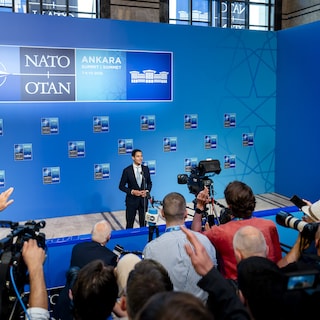
During a press conference in Ankara on July 6th, ahead of a NATO summit, Rutte drew further attention by comparing Trump to Dwight Eisenhower. Rutte suggested that Trump's "extremely forceful" leadership, combined with the threat from Russia, has finally prompted NATO members to meet their defense spending commitments. He also acknowledged Trump's "disappointment" regarding some allies' roles in the Gulf but highlighted the significant contributions of American aircraft and the willingness of Britain, France, and other allies to help defend shipping lanes in the Strait of Hormuz.
Now, due to a combination of Mr Trump’s „extremely forceful” leadership and the threat posed by Russia, NATO members are spending their fair share on defence.
Rutte's strategy of combining strong praise for Trump with factual counterpoints appears to be a deliberate tactic to manage the U.S. president's demands while still advancing NATO's agenda. This approach, while controversial, is seen by many as essential for maintaining transatlantic unity and ensuring continued U.S. engagement with the alliance, especially in the face of Russian aggression.
Yes, Mr Trump had shared his „disappointment” about the role played by some partners in the Gulf, he conceded. But actually almost 5,000 American planes flew sorties from Europe to support Operation Epic Fury.
DistantNews Editorial
Originally published by NRC Handelsblad. Summarized and contextualized by our editorial team with added local perspective. Read our editorial standards.
More Stories
/s3/static.nrc.nl/wp-content/uploads/2026/07/08160139/080726VER_2035073403_1.jpg)
From Our Blog

What Gets Lost (and Found) When News Is Translated

The Critical Role of Diaspora Media in Global News

What Travellers Should Know About Countries with Restricted Press

A Digital Nomad's Guide to Following Local News

How the Same Story Looks Different in Different Countries
