


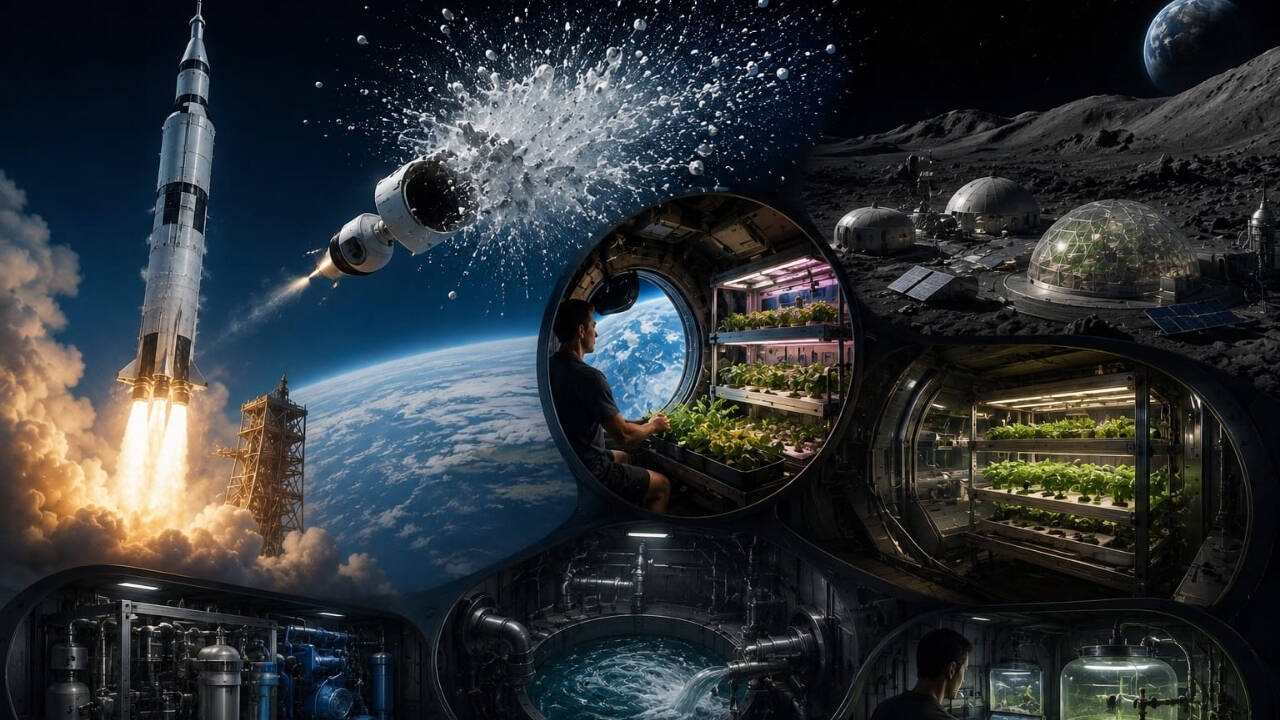
In 1962, NASA exploded 22,900 gallons of water 65 miles above Earth to study the atmosphere
Summarized by DistantNews. Read the original for the full story.
At a glance
News
Sources not specified
Context piece
- In 1962, NASA conducted Project Highwater, detonating 22,900 gallons of water 65 miles above Earth to study atmospheric effects.
- Early NASA research also explored biological life-support systems for long-duration space missions, including resource recycling and the use of living organisms.
- These experiments aimed to understand how to sustain humans in closed environments, laying groundwork for future space settlements.
Decades before current ambitions for lunar bases and Mars missions, NASA was already exploring innovative ways to support human life in space. One such experiment, Project Highwater in 1962, involved detonating 22,900 gallons of water from a Saturn I test rocket at an altitude of approximately 65 miles.
For humans to travel deeper into space and remain there for months or even years, they will need much more than powerful rockets.
This dramatic event allowed scientists to study the behavior of a large volume of water released into the upper atmosphere and its effects. The experiment was part of NASA's broader efforts during the early space age to understand how materials behaved in space and what was required for long-duration human missions.
Beyond atmospheric studies, NASA researchers delved into the concept of closed environments and biological life-support systems. They examined the challenges of creating self-sustaining habitats for astronauts, focusing on resource recycling and the potential role of living organisms. The goal was to move beyond simply carrying supplies from Earth, which becomes increasingly difficult for longer and more distant missions.
In 1962, for example, the agency launched 22,900 gallons of water aboard a Saturn I test rocket and deliberately detonated the water-filled upper stage at an altitude of about 65 miles.
Key to this research was the idea of using biological systems, such as plants, to support human life. Plants, through photosynthesis, could potentially provide oxygen, food, and help process waste, making them valuable components of a life-support system. This early work investigated how to recover and reuse resources within a spacecraft or future planetary habitat, mirroring Earth's natural cycles.
The experiment, known as Project Highwater, allowed scientists to study how the sudden release of such a large volume of water behaved and affected the upper atmosphere.
This foundational research into closed-loop systems and biological support laid the groundwork for understanding the complexities of sustainable living beyond Earth, a challenge that continues to drive scientific and engineering efforts today.
Researchers examined the challenges of creating controlled environments for humans living in space and explored ideas related to biological life-support systems, resource recycling and the role living organisms could play in supporting long-duration space missions.
About this summary
Originally published by Times of India. Summarized and contextualized automatically by DistantNews, with a note on how the source frames the story. Not individually reviewed before publishing. How this works.
More Stories



From Our Blog

What Press Freedom Means for the News You Read

What Gets Lost (and Found) When News Is Translated

The Critical Role of Diaspora Media in Global News

What Travellers Should Know About Countries with Restricted Press

A Digital Nomad's Guide to Following Local News
